Why Doing the Right Thing Doesn’t Always Feel Good

Nowadays, we are seeing a ton of pop psychology and self-help advice that encourages us to prioritize ourselves by:

~Setting boundaries.

~Asserting our needs.

~Emphasizing self-care.

~Giving yourself grace.

Most of this is reasonable advice. However, for most of us, the problem isn’t a lack of information. We already know we should be setting boundaries. We know our needs matter. We know constantly sacrificing ourselves for everyone around us probably isn’t sustainable.

Knowing what to do is often the easy part.

Actually doing it can feel terrible.

When Healthy Choices Create Uncomfortable Emotions

We might assume that doing the “right” thing should feel naturally rewarding or empowering. It may not

Although setting a boundary is healthy, it’s also unfamiliar and can lead to conflict.

Although advocating for myself is appropriate, it can also be awkward and inconvenient.

Although prioritizing my own well-being is necessary, it can feel uncomfortable.

Sometimes doing the right thing for ourselves can be naturally rewarding in the moment. Yet most times doing the right thing comes with feelings of guilt, selfishness, shame, sadness, anxiety, hurt, or even pity for ourselves or the persons affected by our decision.

We might know intellectually that a boundary is reasonable while emotionally feeling like we have done something wrong.

“I know I need to assert my needs, but it’s going to create conflict.”

“I know I need to set this boundary, but what if they think I’m selfish?”

“What if I choose myself and something bad happens to them?”

“I don’t want to be a burden.”

“What if I advocate for myself and they feel hurt?”

These emotions can become powerful enough that we start using them as evidence.

I feel guilty, so maybe I did something wrong.

I feel selfish, so maybe I’m being selfish.

They’re upset, so maybe my boundary was unfair.

But emotions don’t always work that way.

Feeling Guilty Is Not the Same as Being Guilty

Our emotions are real, but that doesn’t mean every conclusion we draw from them is accurate.

You can feel guilty without being guilty.

You can feel selfish without being selfish.

You can feel anxious about conflict without the conflict being dangerous.

You can feel sad that someone is disappointed in you without being responsible for eliminating their disappointment.

That distinction matters.

Many of our emotional responses have been reinforced through years of experience. If you are accustomed to avoiding conflict, prioritizing other people, or receiving approval for being accommodating, suddenly behaving differently might feel wrong even when you consciously believe it is appropriate.

The discomfort isn’t necessarily proof that you made the wrong choice.

It may simply be the emotional experience of doing something different.

Sometimes We Have to Feel Bad

I would love to offer a strategy for setting boundaries, prioritizing yourself, and asserting your needs without experiencing any guilt, anxiety, sadness, or discomfort.

Sometimes we can reduce those emotions. We can challenge irrational beliefs, communicate more effectively, develop greater self-awareness, and make thoughtful decisions about when and how we advocate for ourselves.

But sometimes the uncomfortable emotion is still going to be there.

And sometimes the work is learning that we can tolerate it.

This doesn’t mean ignoring our emotions. It doesn’t mean deciding that we are always right or that other people’s feelings never matter. Emotional discomfort can provide valuable information, and our choices still deserve reflection.

But feeling bad does not automatically mean we behaved badly.

Sometimes we have to allow ourselves to experience guilt without immediately trying to make the guilt disappear.

Sometimes we have to tolerate someone being disappointed in us.

Sometimes we have to accept being misunderstood.

Sometimes we have to experience the anxiety of conflict rather than continually avoiding it.

And through those experiences, we can gradually learn that these emotions are uncomfortable without necessarily being intolerable.

The Goal Isn’t to Never Feel Bad

There is an important difference between trying to eliminate uncomfortable emotions and becoming more capable of experiencing them.

If we require ourselves to feel completely comfortable before setting a boundary, we may never set one.

If we need reassurance that nobody will think we are selfish before prioritizing ourselves, we may continue putting ourselves last.

If we need to know that asserting ourselves won’t create conflict, we may continue staying quiet.

Confidence rarely comes before the behavioral change. It develops because we acted despite the discomfort and discovered that we could handle what follows.

The more capable we become of experiencing these emotions without immediately abandoning our needs because of them, the more freedom we have to make decisions based on our values rather than solely on what feels most comfortable in the moment.

We can set boundaries.

We can advocate for our needs.

We can assert ourselves more confidently.

And we can give ourselves grace when doing those things is harder than we think it “should” be.

Doing the right thing for yourself doesn’t always feel good.

Sometimes the emotional discomfort isn’t evidence that you’re doing something wrong.

It might even be evidence that you’re finally doing something different—and doing the right thing for yourself.


Person jogging on rural road at sunrise with rolling hills and trees

Overcoming Self-Doubt: Lessons from Running

The other day I posted about a running benchmark and captioned it:

“Do impossible sh!t. Then try to beat it. Fall short and still be proud.”

I didn’t get my best distance ever, but I completed a truly hard run.

The tongue-in-cheek “do impossible shit” wasn’t meant as a flex, some form of unbridled toxic masculinity, or an unhinged run-through-a-wall mentality. What I really meant was: do something that a previous version of you couldn’t do. Then keep working on yourself and see what you can do next.

If you’ve followed me for a while, you’ve probably noticed that I’ve become a runner. Of all the stereotypical midlife crisis responses, running has been an unexpectedly healthy one.

It has helped settle my own hypervigilance and helped me regain a sense of stability and confidence through doing hard things. Not because running magically fixes your mental health, but because it has repeatedly given me opportunities to challenge myself and find out what I’m capable of. (In different ways then my career)

I have increased confidence now but only because there was a time when I had very little. I earned trust in myself slowly, by gradually challenging myself to do things I didn’t think I could do.

Here’s the thing, though:

I still very often don’t think I can do stuff.

My routine before a benchmark is now telling anyone at the gym who will listen that I don’t think I have it today. Then, almost immediately, I’ll explain my exact plan to run X speed for Y minutes and what I’m hoping to accomplish.

I plan for what I want despite initially believing I probably can’t actually do it. The self doubt is underneath but not the reality.

And then I try anyway.

The attempt comes first.The plan comes second.The belief comes last.

I think we often imagine confidence working in the opposite direction. First you believe in yourself, then you make the plan, then you confidently go do the thing.

That has not been my experience.

The belief came from repeatedly attempting things before I was convinced I could do them. Sometimes I succeeded. Sometimes I fell short. But every attempt gave me a little more evidence about what I could handle.

Running has also become a pretty good illustration of my own cognitive process and, specifically, my all-or-nothing thinking. In a matter of minutes—maybe even seconds—I can vacillate between thinking I am unstoppable and thinking I am way too out of shape for this.

I suppose neither is true.

The truth is somewhere in the healthy middle.

I am not unstoppable. I can’t do the impossible. There are things I will attempt and fail at. There are goals I won’t reach and days when I genuinely don’t have it.

But I can do hard shit.

And maybe confidence isn’t believing that you’re going to succeed every time. Maybe it’s trusting that you can attempt something without knowing how it’s going to turn out.

That trust has been earned slowly.

One run. One workout. One race. One benchmark. One uncomfortable thing at a time.

So when I say, “Do impossible shit, then try to beat it,” I’m not really talking about doing the impossible.

I’m talking about doing something that feels impossible to you right now.

Then seeing what you can do next.

Person jogging on rural road at sunrise with rolling hills and trees
Brightly colored transparent bubbles connected by glowing neon lines on dark background

You Don’t Have to Know How: Embrace the Journey

This week I completed my 600th group fitness class. It’s been almost 3 years and extremely transformative.

Since joining this community I’ve completed two half marathons in the past year. (I’ll be signing up for a third soon.) I’m confidently in the best shape of my life.

What surprises me most isn’t where I am.

It’s that, looking back, I have absolutely no idea how I got here.

I didn’t have a five-year fitness plan. I wasn’t trying to become “a runner.” I never had completing half marathon’s at 40 years old on the bucket list. I wasn’t really counting down to my 600th class. I paid attention to 500 but 600 just sort of showed up.

But really I just kept showing up.

Fittingly, this concept has weaved it’s way into conversation I have with many of my therapy clients over the past few weeks. I noticed this trend of: “I don’t know how to do this.”

Whether it’s changing careers, improving a relationship, managing anxiety, starting therapy, exercising consistently, or making any meaningful life change, we often believe we need to know exactly how to do things before we get started.

But that’s rarely how growth works.

You don’t have to know how you’re going to be successful.

You discover the “how” by repeatedly taking the next step.


Brightly colored transparent bubbles connected by glowing neon lines on dark background

Mental Health and Physical Health Were Never Separate

One unexpected consequence of consistently exercising wasn’t just that I became physically healthier.

I became mentally healthier too.

Not because exercise replaced therapeutic principles.

Because it changed the environment my mind existed in.

Regular exercise gave me structure which:

  • improved my sleep.
  • challenged my negative self talk or doubt
  • introduced a supportive community
  • held me accountable
  • motivated me with others
  • increase my faith in others by actively seeing people working toward their own goals.

None of those things cured stress.

None of them eliminated anxiety.

But together, they made me more resilient.


Exercise Isn’t Therapy

Sometimes conversations about mental health become overly simplistic.

You’ll hear people say:

“Just exercise.”

As though depression, trauma, OCD, or panic disorders can simply be run away from.

That’s not how mental health works.

Exercise is not psychotherapy.

A treadmill cannot help you process grief.

Deadlifts won’t challenge deeply rooted cognitive distortions.

A long run won’t repair childhood trauma.

There are experiences that require reflection, insight, emotional processing, and sometimes evidence-based psychotherapy or medication.

Exercise is an incredible supplemental intervention.

It’s just not the intervention.


Therapy Isn’t Just for Mental Illness Either

The opposite misconception exists too.

Many people think therapy only exists to treat disorders.

I don’t believe that’s true either.

Just as people exercise before they develop heart disease…

People can benefit from therapy before they’re in crisis.

Therapy can help you develop healthier relationships.

Increase self-awareness.

Clarify your values.

Improve communication.

Process major life transitions.

Build resilience.

Or simply become more intentional about the life you’re creating.

Sometimes therapy isn’t about fixing something that’s broken.

Sometimes it’s about building something meaningful.


Wellness Is an Interactive System

Physical health influences mental health.

Mental health influences physical health.

Better sleep improves emotional regulation.

Lower stress makes it easier to exercise.

Exercise improves confidence.

Confidence increases willingness to pursue difficult goals.

Healthy relationships improve motivation.

Purpose increases consistency.

Each area reinforces the others.

They’re less like separate buckets and more like interconnected gears.

When one begins to move, the others often become easier to move as well.


The Goal Was Never 600 Classes

If you had asked me years ago whether I’d complete 600 classes, I probably would have laughed it off.

“I’m not a joiner. I’m a solo practitioner, independently motivated man.”.. Welp… There goes that self-limiting schema.

I didn’t know how I’d get here.

I didn’t need to.

I only needed to decide on a direction.

Everything else came from showing up consistently and seeing where the journey would take me. We dictate the current but then go with flow.

One workout. One therapy session. One difficult conversation. One healthy choice.

One uncomfortable moment at a time…

can lead to some of the most meaningful changes in our lives. Success isn’t usually the result of having the perfect plan.

It’s the result of consistently becoming the kind of person who keeps moving forward

What “I Have Nothing to Talk About” Can Actually Mean

There are certain phrases psychotherapists hear that immediately get our attention.

One of them is:

“I have nothing to talk about.”

Now, if I’m being honest, most therapists don’t hear that statement and simply take it at face value.

We get curious.

Is there something they are avoiding?

Is there something they’re glossing over?

Is this an opportunity to dive deeper into something?

What uncomfortable feeling are we dancing around?

After all, avoidance is one of the most common patterns people bring into therapy.

Not because they’re dishonest.

Not because they’re resistant.

Because they’re human.

Why We Avoid

Avoidance gets a bad reputation, but it exists for a reason.

If something feels painful, uncomfortable, embarrassing, uncertain, or overwhelming, our minds naturally try to move away from it.

We change the subject.

We distract ourselves.

We stay busy.

We tell ourselves we’ll deal with it later.

We convince ourselves it isn’t a big deal.

For a brief moment, avoidance works.

That’s why people do it.

The difficult conversation gets postponed.

The anxiety temporarily decreases.

The uncomfortable emotion fades into the background.

The problem is that while avoidance often provides short-term relief, it tends to create long-term suffering.

The conversation still needs to happen.

The decision still needs to be made.

The grief still needs to be felt.

The fear still waits for us.

One of the primary goals of therapy is helping people gradually build the ability to approach the things that they would rather avoid.

Not because it’s pleasant.

Because it’s often necessary for change.

The Therapist’s Suspicion

This is why therapists become suspicious when someone says they have nothing to talk about.

We’ve heard it before.

Sometimes “nothing to talk about” means:

“I don’t want to discuss the fight I had with my spouse.”

Sometimes it means:

“I don’t want to admit how anxious I’ve been.”

Sometimes it means:

“I know exactly what I need to talk about, and I’m hoping we can spend the session discussing the weather instead.”

Years of experience teach us that there is often something sitting beneath the surface.

Which is exactly why a recent session stuck with me.

Sometimes There Really Is Nothing To Talk About

About fifteen minutes into a session, a client told me they didn’t really have anything to discuss.

My therapist brain immediately started searching.

Work?

Family?

Goals?

Stressors?

Future plans?

I explored a few areas.

And what I found surprised me.

There wasn’t a hidden crisis.

There wasn’t a conflict being avoided.

There wasn’t some painful topic hiding behind the curtain.

Things were simply okay.

Not perfect.

Just okay.

And that’s different.

There was still some anticipatory anxiety about the future. There always is. Life doesn’t stop being uncertain simply because things are going well.

But in this particular moment, this person had achieved many of the goals they had worked toward.

They had made significant changes in their career.

They felt more secure in themselves.

They were handling challenges effectively.

They had done the work.

Peace Can Feel Unfamiliar

What struck me was how unusual this moment felt.

Not because peace is rare.

Because we often don’t know what to do with it.

Many people become so accustomed to solving problems that they struggle to recognize when there isn’t one.

We become scanners.

Always looking for the next issue.

The next challenge.

The next thing to fix.

The next source of stress.

Sometimes this mindset is useful.

Sometimes it helps us grow.

But sometimes it prevents us from appreciating where we currently stand.

It’s difficult to enjoy a view when you’re constantly looking for the next mountain to climb.

Celebrating Progress

So instead of searching harder for a hidden problem, we spent time acknowledging something important:

How they got to this moment of quiet peace.

We talked about the work they had done.

The changes they had made.

The growth they had achieved.

The discomfort they had tolerated.

The risks they had taken.

The person they had become.

Therapy often focuses on what’s wrong.

Naturally so. People usually come to therapy because something isn’t working.

But growth deserves attention too.

Progress deserves attention too.

The absence of suffering isn’t always avoidance.

Sometimes it’s evidence.

Evidence that the hard work is paying off.

A Final Thought

Not every therapy session is challenging because life is difficult.

Sometimes the challenge is learning to be at peace when life isn’t difficult.

Sometimes the work is allowing yourself to stop searching for a problem and simply acknowledge:

“I’m okay right now.”

That may not sound like much.

But for someone who spent years anxious, overwhelmed, self-critical, or stuck in survival mode, that moment can be one of the greatest achievements of all.

Why the Knicks Championship Means So Much Psychologically

Collage of New York Knicks players celebrating their 2026 NBA Championship victory with a basketball graphic in the background.

The Emotion

The Knicks winning a championship was a beautiful moment.

Of course, it was a beautiful moment for Knicks fans who had been waiting 53 years.

I cried almost immediately.

As the final minute ticked away, I felt myself welling up numerous times. Then when the final buzzer sounded I hugged my 11-year-old daughter and cried. I don’t think she fully understood what was happening or what this meant. How could she?

She’s 11.

When we’re 11, we expect our teams to win eventually. We expect our needs to be met. We assume the world is mostly fair. We root for our team, invest our time and energy, and naturally believe that one day it will all pay off.

Then she saw my reaction and wrapped her arms around me in a hug that felt like she understood that this was important to me.

I’ve wanted to see the Knicks win a championship since I was eight years old.

And they finally did it.

The Belief

After Game 2, standing in a crowded hometown sports bar, I kept repeating the same two phrases:

“We’re watching history.”

“It’s happening.”

After Game 4, following what will surely be remembered as one of the defining moments of this playoff run, the feeling only intensified.

“This is happening.”

“It’s really happening.”

The disbelief was understandable.

7 years ago, the Knicks were the laughingstock of the league. They were the team that threw passes off players’ backs, missed uncontested layups, and found creative ways to lose games in the final seconds. For decades, disappointment felt more predictable than success.

Many Knicks fans jokingly refer to this as “Knicks Fan PTSD.”

The comparison is obviously imperfect. Losing basketball games is not actually traumatic for fans. But there is something psychologically interesting about the phenomenon.

After enough disappointment, we learn to expect disappointment.

It’s anticipatory anxiety. It’s negative thinking and looking for the worst. We anticipate that what could go wrong will go wrong. We brace ourselves for the collapse before it arrives. We become convinced that if there is a painful way for the story to end, that’s probably how it will end.

It’s learned behavior—a belief formed through repeated experiences.

And while we’re talking about basketball, this isn’t really unique to sports.

People who have experienced repeated rejection often begin to expect rejection.

People who have been hurt in relationships may start anticipating abandonment.

People who have failed repeatedly can lose faith in their ability to succeed.

Our brains are constantly trying to predict the future based on the past. Sometimes those predictions protect us. Sometimes they keep us stuck.

That’s what made this championship feel so surprising.

For once, the story didn’t end the way many of us expected. It didn’t reinforce the negative narrative but provided a positive alternative.

The Community

Part of what made this championship feel so powerful was that it wasn’t a solitary experience.

Over the past few weeks I’ve talked Knicks basketball with clients, friends, strangers at bars, people at the gym, the pool guy, and landscapers outside my office.

For a brief period of time, an entire region was participating in the same conversation.

Sports create something increasingly rare in modern life: a shared experience.

We all watched the same games. We all felt the same tension. We all carried the same hope. And when the final buzzer sounded, millions of people celebrated together.

Maybe that’s part of why the victory felt bigger than basketball. It wasn’t just my joy. It was our joy.

Effort Over Outcomes. But We Still Love Outcomes

Now, logically, I know I didn’t earn anything.

I’ve had quarter-season tickets for the last four years. I’ve attended games, bought the merchandise, paid for the subscriptions, and invested countless hours watching and discussing Knicks basketball. But I did those things because I enjoyed them, not because I expected repayment.

The Knicks don’t know who I am.

They don’t owe me anything.

For most of the last twenty years, they barely seemed capable of functioning as a competent basketball organization despite having one of the most loyal fan bases in sports.

And yet, when they finally won, it still felt personal.

A few months ago, I made a video about one of life’s hardest truths: Trying your best does not guarantee results. I know that to be true. I suspect most people carry some version of this belief. We want to believe that if we work hard enough, long enough, good things can happen.

Not always.

Not automatically.

But sometimes.

In therapy, I often meet people who have lost faith in that possibility. After enough setbacks, enough disappointments, enough evidence pointing in the wrong direction, hope begins to feel naive.

It’s understandable.

But meaningful change often requires believing in a future that doesn’t yet exist.

Watching Jalen Brunson lead this team to a championship felt like watching that belief come to life.

There are no guarantees in therapy. There are no guarantees in business. There are no guarantees in relationships, health, or life.

But I still operate with a deeper belief.

I believe that if I exercise regularly, I’ll be healthier, stronger, and more capable tomorrow than I am today.

I believe that effort matters.

Not because it guarantees outcomes, but because it improves the odds.

In Summary…

I cried for a complex combination of reasons.

Not simply because my favorite basketball team finally won.

I cried because the moment validated something deeper.

It reinforced the idea that persistence matters.

That improvement is possible.

That years of frustration don’t always end in disappointment.

That occasionally, hard work and hope intersect.

As a therapist, I can never promise someone that things will get better. It would be dishonest to make guarantees about life.

But I do believe people can get better.

I believe relationships can heal.

I believe confidence can be built.

I believe suffering can be reduced.

I believe effort, applied consistently over time, can create meaningful change.

Maybe that’s why this championship hit me so hard.

For one night, millions of Knicks fans weren’t just celebrating basketball.

We were celebrating hope actualized.

We were celebrating the proof of concept that things can improve.

We were celebrating the idea that after enough work, enough patience, and enough belief, something wonderful might finally happen.

Overcoming Social Isolation: Tips for Meaningful Engagement

A circle of wooden chairs arranged on a stage with theater seats in background

Have you ever felt left out? Other people made plans and somehow you weren’t included. That can feel extremely hurtful and deeply personal.

For many people, exclusion triggers feelings of rejection or abandonment. Those already struggling with isolation or loneliness may feel an even stronger urge to retreat inward. Or worse, the pain can come out sideways through anger, bitterness, passive aggression, or resentment.

Ironically, feeling excluded often changes how we behave socially — and can unintentionally create even more disconnection.

Like many things we talk about, fighting the trigger usually doesn’t help. Acceptance does.

Unfortunately, the child who feels left out will understandably pout or complain that nobody included them. But while the reaction makes sense emotionally, it usually doesn’t create more positive social interaction afterward.

Adults do this too.

The parent who guilts their adult children for not calling enough.
The friend who keeps score of invitations.
The partner who focuses on needing more reassurance.

When we become hyper-focused on rejection, we can unknowingly reinforce the very isolation we’re trying to escape.

It’s not about less rejection. It’s about more connection.

It’s not the absence of the negative (exclusion), but the presence of the positive (inclusion).

Instead of staying stuck on:
“Why was I excluded?”

Shift toward:
“How can I participate more?”
“How can I contribute socially?”
“What role can I offer here?”
“What do I genuinely appreciate about this person or group?”

And participating more doesn’t necessarily mean taking up more space. Sometimes it means providing more space.

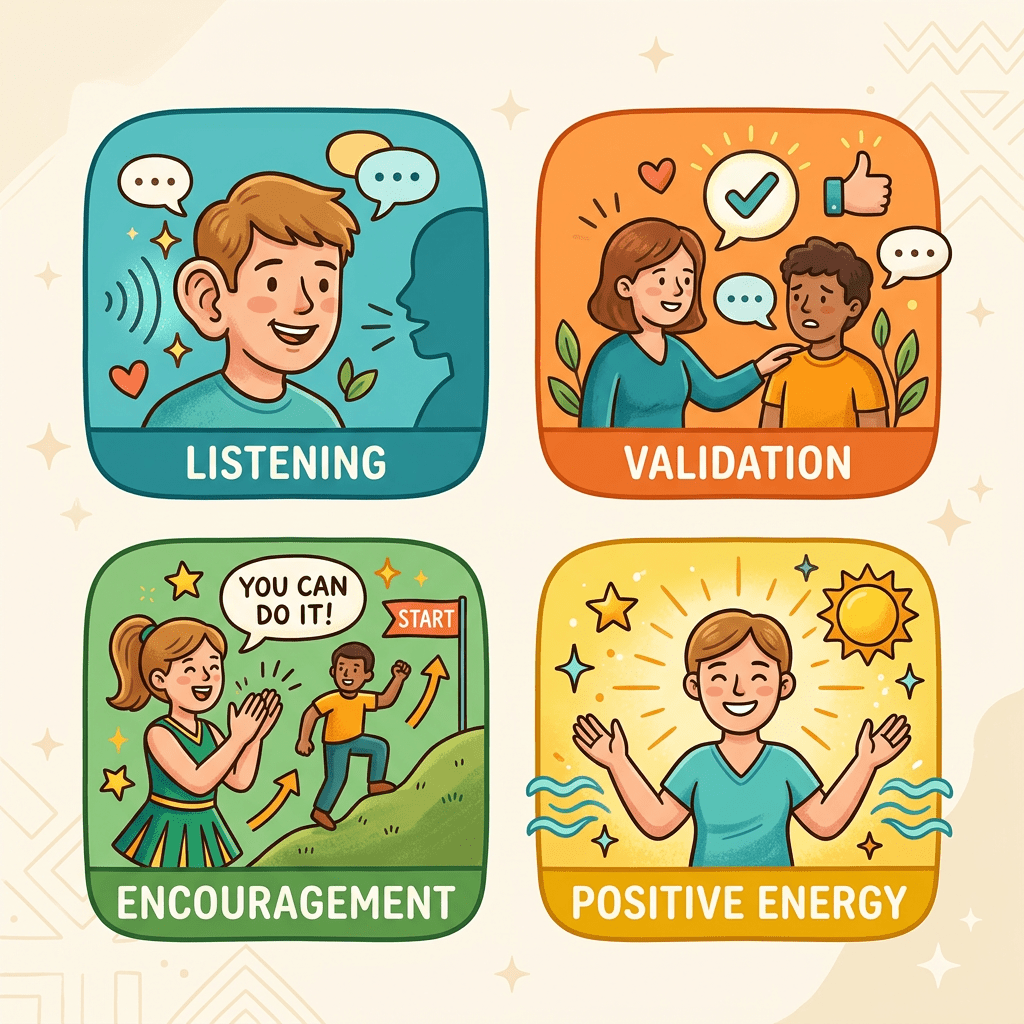
Active listening.
Validation.
Encouragement.
Humor or playfulness.
Positive energy.
Curiosity about others.

Four illustrations labeled listening, validation, encouragement, and positive energy showing supportive communication

Taking a healthy active role socially usually isn’t loud. Most of the time it’s subtle.

People naturally gravitate toward those who feel present, engaged, welcoming, and enjoyable to be around. That doesn’t mean becoming fake or performing for approval. It means recognizing that connection grows through participation.

For the person who feels disconnected from family.
The adult with grown children they rarely hear from.
The partner craving more quality time or attention.

Constantly highlighting your hurt or demanding fairness usually doesn’t create closeness. Connection tends to grow through more pleasant, present, emotionally safe interactions.

Just as constantly looking for exclusion can trigger undesirable reactions, looking for evidence that we are wanted and included often creates healthier ones.

The more connected and at ease we feel, the more likely we are to participate positively, engage socially, and create enjoyable experiences with others.

And yes — sometimes this means becoming someone who is a little more fun to be around, even if it initially feels unfamiliar or unnatural.

Not fake.
Not performative.
Just more engaged with life.

You probably don’t actually want the pity invite anyway.
The invite out of obligation.
The forced fairness invite.

That doesn’t satisfy the social craving.

Connection does.

So start connecting.

And if connecting with others feels difficult right now, connect with yourself first.

Forest path with sun rays shining through tall trees and leafy plants

Go for a nature walk.
Exercise.
Play an instrument.
Write something.
Paint.
Take a class.
Develop hobbies.
Create things.
Do shit for the fun of it.

Fun creates energy.
Energy creates engagement.
Engagement creates connection.

Feeling badly for ourselves reinforces isolation. Participation interrupts it.

Be present and be pleasant.

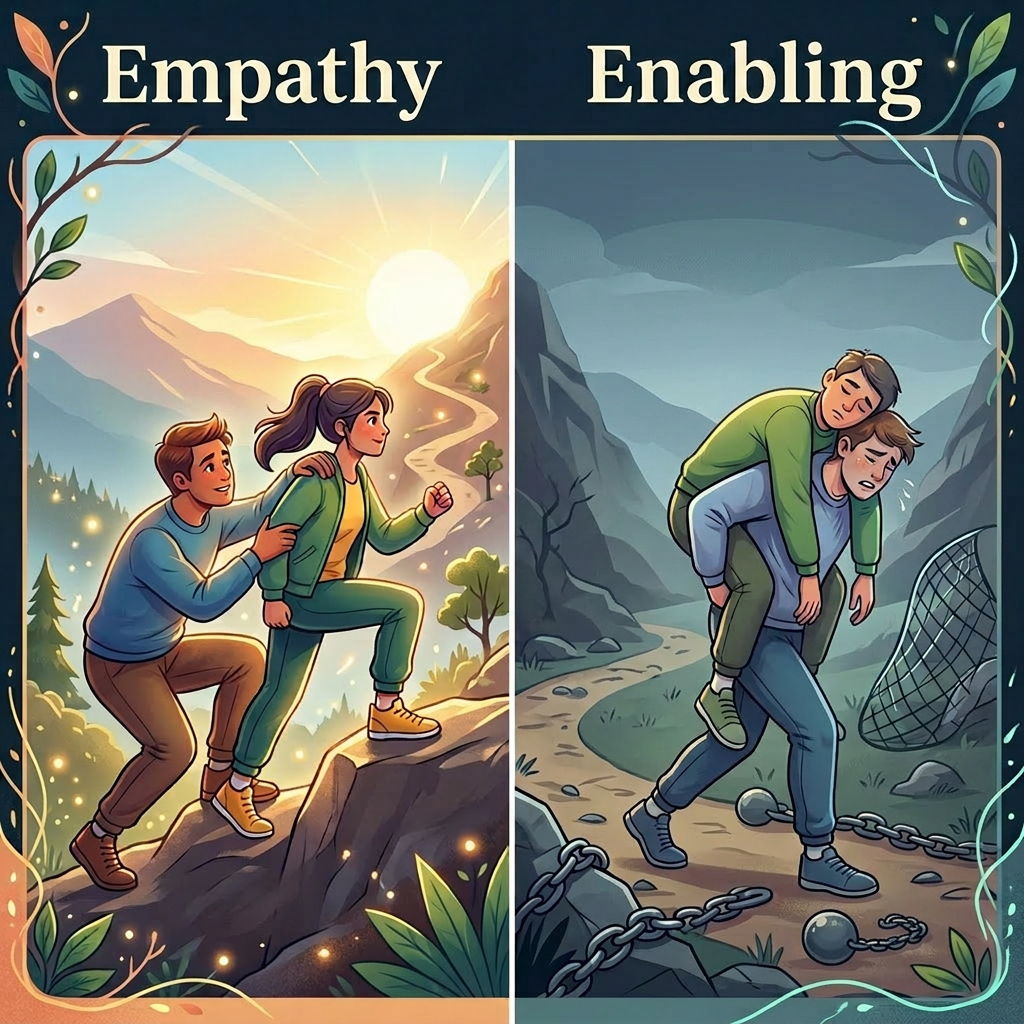
Empathy or Enabling? Know your limits.

Remove all text near people

Empathy is essential for human connection. It allows us to understand and support each other. It’s important to validate the emotional experiences of others in order to strengthen are most meaningful relationships. So at its core, empathy is necessary for healthy relationships

But empathy also has a limit. It’s not an endless resource.

It can take a lot out of us. Especially when it goes beyond understanding and into over-involvement, codependency, or enmeshment. Empathy to the Nth degree can begin to work against the very growth it’s meant to support.

A Spectrum of Empathy

Like most nuanced psychological principles – it can be most helpful to think of empathy as existing on a spectrum. Not all or nothing. Not binary. But with shades of grey

On one end, we often criticize and distance ourselves from those who lack empathy. Seeing the existence of empathy as an automatic positive.

Which empathy can be when grounded and with appropriate boundaries. This balanced or healthy empathy allow us to recognize someone else’s emotional experience without taking it on as our responsibility. This form of empathy supports both connection and autonomy. This is “true empathy” that is consistent with emotional intelligence.

When Empathy Becomes Self-Focused

However, for some as empathy intensifies, it can shift from selfless to selfish. We may begin to feel not only with someone, but for them to the point that their discomfort becomes difficult for the empathizer to tolerate.

At this far end of the spectrum, empathy becomes enabling when the empathizer finds themselves desperately trying to remove the discomfort from the other person. This happens when we claim to feel so badly for someone else that we no longer want them to feel it. But removing someone else’s opportunity for an emotional response, (including negative emotions) no matter how well intentioned is ultimately self serving.

This becomes limiting for one party and burdensome for the other. Instead of being about the other person’s experience, it becomes about the empathizers discomfort with their experience.

If we step in, fix, soften, or carry the emotional weight— we are not helping them, but relieving what we are feeling in response to it.

In that sense, empathy that has exceeded its limit can become more self-focused than it appears.

Why This Matters

Emotional discomfort plays an important role in growth.

Feelings like frustration, regret, or sadness are not problems to be eliminated—they are part of how people learn, adapt, and develop resilience.

When we consistently remove or absorb that discomfort for others, we may unintentionally limit their ability to build those skills.

Support does not require removing the experience. It requires allowing space for it.

Differentiating the Difference

A useful distinction is this:

  • Empathy says: “I see you and understand what you’re feeling.”
  • Enabling says: “I’ll take this from you so you don’t have to feel it.”

The difference is not in how much we care, but in how we respond to that care.

Conclusion

Empathy is not the problem. In fact, it’s necessary.

But when it goes beyond a healthy limit—when it shifts from understanding to over-carrying—it can become counterproductive.

You can care deeply about someone
without carrying what is theirs to feel.

That balance is where empathy is most effective.

A motivational quote over a background of burning firewood that reads: 'you are not required to set yourself on fire to keep other people warm.'
Three people playing basketball and laughing on an outdoor court at sunset

Fun Isn’t Frivolous: It’s Fuel for Life

Three people playing basketball and laughing on an outdoor court at sunset

Lately I’ve been thinking a lot about fun We love it and yet we are not having enough of it.

We are often entertained. Frequently wanting a distraction. Planning future events. But not let ourselves have real fun in the moment.

Somewhere along the way, too many of us lose touch with it. I hypothesis it starts in teenage years when we start feeling societal pressure and demands. We slow start taking life too seriously. Then in adulthood we gradually add responsibilities and start prioritizing productivity, milestones, achievement, and earnings. We treat fun like a reward we earn after handling our responsibilities.

The problem is… life is a series of problems. So the responsibilities are never fully handled.

There will always be another email, another call, another task, another goal, another pressure, and another metric. If we try fun as future priority we won’t have it. “I’ll be happy when… turns into I can’t be happy now”

Anxiety Might Push You. Fun Sustains You.

As a psychotherapist who works with perfectionism and overthinking, I see a lot of performance-based anxiety.

The pressure to succeed.
The pressure to do more.
The pressure to always be improving.

And to be fair, anxiety can be useful in the short term.

A lot of high achievers are productive because of anxiety. It helps them stay sharp, stay driven, stay on top of things.

But the issue is sustainability.

You can absolutely build success through pressure.
You just usually can’t hold onto it for too long.

That’s where fun comes in.

Fun prevents burnout.
Fun reinvigorates us.
Fun pulls us out of performance mode and back into the present moment.

So even if anxiety pushes us towards success initially- fun is what can help keep us succesful .

Life Was Never Meant to Be Only Outcomes

When you listen to your favorite song, it isn’t about getting to the end of the song.

It’s about singing along. Maybe dancing badly in your kitchen with your loved ones.

When you play sports or board games with your kids, it isn’t about finishing the game.

It’s about playing – the laughing, bonding, harmless competition, and creating memories.

When you go on vacation, it sure as hell isn’t about get back home. It’s not completing the trip.

It’s enjoy it. Having fun along the journey.

Somewhere along the way, many adults start treating life like one giant checklist. Finish the task. Reach the milestone. Get to the next thing.

But life was never meant to only be completed.

It was meant to be lived.

What Is “True Fun”?

We all know what fun is in theory. But I think it helps to define it more clearly.

True fun usually includes three things:

1. Playfulness

Not taking everything so seriously. Room for humor, silliness, spontaneity.

2. Flow

Being immersed enough in the moment that you forget your to-do list for a while.

3. Connection

Sharing moments, laughter, energy, or meaning with others.

That might look like:

  • Playing ping pong and laughing at the ridiculous points in between keeping score
  • Singing karaoke in the kitchen and forgetting what day it is
  • Sitting at dinner with family, recapping the day and joking around
  • Shooting hoops with no agenda other than enjoying yourself
  • Going for a walk and actually noticing the day

Fun often sounds small. But its impact is not small.

Fun Helps Mental Health

Fun is not a cure for anxiety or depression.

But it can be a powerful part of healing.

Fun can help us reconnect with ourselves.
It can remind us we are more than our stress.
It can increase willingness to participate in life again.
It can restore confidence, connection, and energy.

Sometimes people think mental health is only about deep work, heavy conversations, fixing problems.

That matters too.

But healing also happens in laughter.
In movement.
In shared moments.
In joy that doesn’t need to be earned.

This Week, Try This

Don’t ask only:

“What do I need to get done?”

Also ask:

“What can I do to make this day more fun?”

That question can change more than people realize.

Because fun isn’t childish.
It isn’t lazy.
It isn’t extra.

Fun is often the thing that makes life feel like life again.

Embrace Change: The Power of Identity in Personal Growth

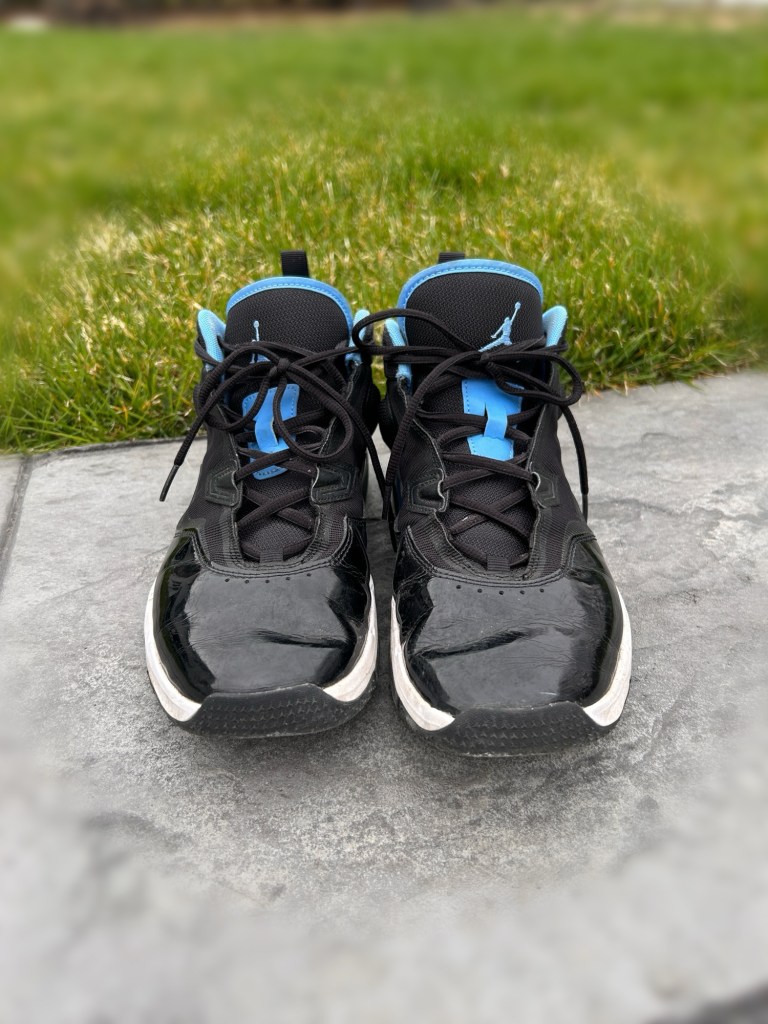
A pair of black and blue basketball shoes placed on a stone surface with green grass in the background.

I shared this story with someone recently who was struggling with identity, confidence, and feeling stuck. The more I thought about it, the more I realized it applies to a lot of people—personally and professionally.

Some people will remember the early days of me doing all-out sprints in Jordans. I’m lucky my knees survived.

At the time, it made perfect sense to me.

Not because they were built for running. They weren’t. It made sense because they matched who I believed I was.

Basketball was my sport. Basketball had culture. It had confidence, energy, familiarity. It was part of my history. Running, on the other hand, was something you did for conditioning. It wasn’t something I identified with. It belonged to a different type of person.

That distinction mattered more than I understood.

Because many of us do this in life.

We step into something new while trying to preserve an old identity. We say we want growth, but we bring outdated self-perceptions into new environments. We want new results while staying emotionally attached to the version of ourselves that feels familiar.

That creates friction.

Eventually, after enough feedback, my stubborn ass bought real running shoes.

Small purchase.

Big shift.

The shoes didn’t magically change my life. They didn’t make me faster overnight. They didn’t transform me into a runner.

What they did do was signal that I was ready to take this new chapter seriously.

They helped me stop relating only to who I had been and become more open to who I was becoming.

That’s an important distinction.

Real change usually starts with action. You show up. You practice. You make better choices. You build consistency.

But sustainable change often requires something deeper: a shift in identity.

You stop saying, “I’m trying to do this.”

And start saying, “This is part of who I am now.”

That applies everywhere:

The person trying to become healthier while still seeing themselves as someone who always quits. The professional stepping into leadership while still thinking like they need permission. The person rebuilding after divorce, loss, or burnout while still defining themselves by the old chapter. The entrepreneur trying to grow while still attached to the safety of playing small.

Behavior matters.

But behavior becomes more powerful when it aligns with identity.

I had already started running before I bought those shoes. But it wasn’t until I changed how I saw myself that it started to feel meaningful.

Sometimes the next level of growth isn’t more effort.

It’s updating the story you keep telling yourself.

You don’t need to start running.

You don’t need to buy new shoes.

But if you’re stuck between who you’ve been and who you want to become, remember:

You don’t have to run in Jordans.

Why Insight Alone Can’t Change Your Mental Health

A 3D illustration of a human brain with mechanical gears integrated into its structure, glowing with a soft red light against a pale background.

Most of my clients have incredible insight into their mental health. Many people who attend CBT therapy for anxiety or depression already know what they’re supposed to do. They understand it intellectually but still struggle.

They know when their thoughts are irrational.

They know avoidance worsens anxiety.

They know isolation feeds depression.

And yet—nothing changes.

This gap between knowing and doing isn’t a lack of intelligence. It’s certainly not for lack of effort. It’s a misunderstanding of how psychological change actually happens.

Insight Alone Rarely Creates Change

Cognitive Behavioral Therapy (CBT) emphasizes the connection between thoughts, emotions, and behavior. Understanding your thinking patterns matters. Learning how to challenge unhelpful beliefs matters.

But insight alone rarely leads to sustainable growth.

Many people can accurately identify their cognitive distortions. They can explain why their anxiety “doesn’t make sense.” They may intellectually understand why avoidance keeps them stuck. Yet, they still feel anxious, depressed, or unmotivated. Sitting alone with your thoughts and repeatedly trying to think happy thoughts is not CBT. In fact, trying to think ourselves out of emotional distress often becomes exhausting.

Knowing what would help doesn’t automatically make it easier to do it.

Practice Over Theory

My clinical approach is grounded in Rational Emotive Behavior Therapy (REBT). This is a form of CBT that places particular emphasis on how rigid beliefs and internal demands fuel emotional distress.

From an REBT perspective, we work to replace demands (“shoulds,” “have tos,” and “musts”) with preferences. So we don’t have to do the work—we prefer to do the work, because we prefer to see progress.

But simply put, we still have to practice what we know.

Don’t just talk about it—be about it.

This applies to me as well. I can’t just preach mental health and wellness; I have to actively work at living by it. (Maybe that’s why they call it a private practice). What I practice in private tends to show up in the therapy office.

If I’m burned out, overextended, or ignoring my own limits, that doesn’t stay neatly contained outside of session. Practicing self-care isn’t just something I encourage—it’s something I actively work on. Being present, emotionally attuned, and grounded with clients requires ongoing practice, not just theoretical understanding. I am not alone, nor am I special. This is part of the human experience.

“I Give Great Advice—Just Not to Myself”

Many clients describe themselves as the wise friend—the one who gives thoughtful advice. They validate others’ emotions and see situations clearly from the outside. Yet, they struggle when it comes to their own life.

Often this happens because we:

  • Validate others’ emotions while minimizing our own
  • Apply compassion outward but demand perfection internally
  • Know what helps in theory but avoid it when it feels uncomfortable
  • Let ego convince us we “shouldn’t have to do the work”

This isn’t hypocrisy. It’s human behavior. And it reinforces the same idea: knowing is not the same as practicing.

When You Know What to Do—but Still Can’t Do It

A common frustration I hear in therapy sounds like this:

“I know I shouldn’t isolate, but when I’m depressed I don’t want to burden others.”
“I know structure or exercise would help, but I can’t get myself to start—or even get out of bed.”
“I know no one is judging me at this party, but I’m still worried I’ll look foolish.”

At this point, many people assume something is “wrong” with them. In reality, they’re encountering a very normal limitation of insight-based change.

CBT isn’t about waiting to feel better before acting. It’s about learning how to act while uncomfortable. Or, as I like to say, the beauty is in the work.

Midsteps: Acting Without Needing to Feel Ready

When anxiety or depression is present, meaningful change rarely comes from trying harder or thinking more rationally first. Instead, we focus on midsteps—small, intentional actions that are possible even when motivation is low.

For example:

You don’t go to the crowded store, but you walk to the mailbox
You don’t socialize for hours, but you step outside briefly
You don’t feel confident, but you take action anyway

These steps aren’t about eliminating discomfort. They’re about moving through it—gradually demonstrating to yourself that you can withstand it.

Experiential Knowledge Is What Changes Beliefs

In CBT and REBT, beliefs change most reliably through experience—not logic alone. While we may brainstorm cognitive reframes in session to reduce stress and anxiety, long-term growth comes from experiential learning and resilience-building.

Experiential knowledge is built by:

  • Doing difficult things while anxious
  • Acting while depressed, unmotivated, or self-critical
  • Learning firsthand that discomfort is tolerable
  • Developing resilience to frustration

Sometimes those actions feel empowering. Other times they come with sweating, self-doubt, tears, or a pit in your stomach.

It all counts.

Each experience provides evidence that:

“I can tolerate discomfort and still function. I can withstand this.”

Over time, this weakens avoidance and reshapes emotional responses—not through positive thinking, but through repeated practice.

Therapy as a Place to Practice, Not Just Understand

Therapy isn’t about convincing yourself you shouldn’t feel anxious or depressed.

It’s about learning how to act effectively while you do.

For clients seeking CBT therapy for anxiety or depression, this approach often resonates with people. It particularly appeals to those who value self-improvement. They emphasize personal responsibility and intellectually honest change.

That’s why knowing isn’t enough—and why meaningful progress comes from practice over theory.