Embrace Change: The Power of Identity in Personal Growth

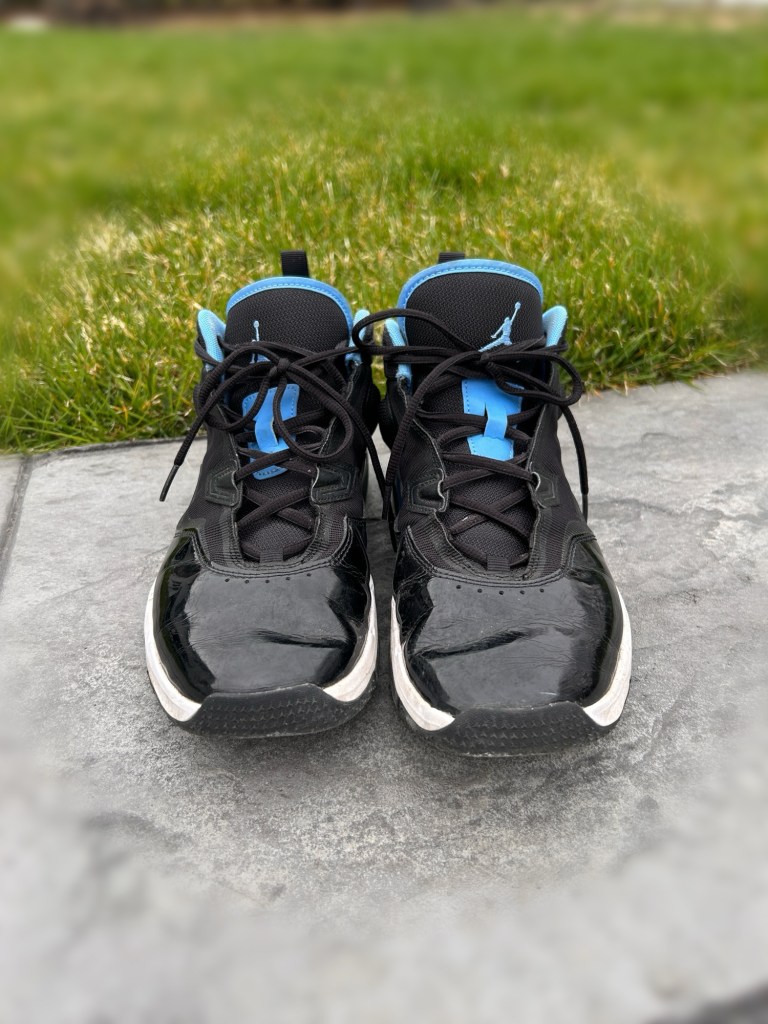
A pair of black and blue basketball shoes placed on a stone surface with green grass in the background.

I shared this story with someone recently who was struggling with identity, confidence, and feeling stuck. The more I thought about it, the more I realized it applies to a lot of people—personally and professionally.

Some people will remember the early days of me doing all-out sprints in Jordans. I’m lucky my knees survived.

At the time, it made perfect sense to me.

Not because they were built for running. They weren’t. It made sense because they matched who I believed I was.

Basketball was my sport. Basketball had culture. It had confidence, energy, familiarity. It was part of my history. Running, on the other hand, was something you did for conditioning. It wasn’t something I identified with. It belonged to a different type of person.

That distinction mattered more than I understood.

Because many of us do this in life.

We step into something new while trying to preserve an old identity. We say we want growth, but we bring outdated self-perceptions into new environments. We want new results while staying emotionally attached to the version of ourselves that feels familiar.

That creates friction.

Eventually, after enough feedback, my stubborn ass bought real running shoes.

Small purchase.

Big shift.

The shoes didn’t magically change my life. They didn’t make me faster overnight. They didn’t transform me into a runner.

What they did do was signal that I was ready to take this new chapter seriously.

They helped me stop relating only to who I had been and become more open to who I was becoming.

That’s an important distinction.

Real change usually starts with action. You show up. You practice. You make better choices. You build consistency.

But sustainable change often requires something deeper: a shift in identity.

You stop saying, “I’m trying to do this.”

And start saying, “This is part of who I am now.”

That applies everywhere:

The person trying to become healthier while still seeing themselves as someone who always quits. The professional stepping into leadership while still thinking like they need permission. The person rebuilding after divorce, loss, or burnout while still defining themselves by the old chapter. The entrepreneur trying to grow while still attached to the safety of playing small.

Behavior matters.

But behavior becomes more powerful when it aligns with identity.

I had already started running before I bought those shoes. But it wasn’t until I changed how I saw myself that it started to feel meaningful.

Sometimes the next level of growth isn’t more effort.

It’s updating the story you keep telling yourself.

You don’t need to start running.

You don’t need to buy new shoes.

But if you’re stuck between who you’ve been and who you want to become, remember:

You don’t have to run in Jordans.

Why Insight Alone Can’t Change Your Mental Health

A 3D illustration of a human brain with mechanical gears integrated into its structure, glowing with a soft red light against a pale background.

Most of my clients have incredible insight into their mental health. Many people who attend CBT therapy for anxiety or depression already know what they’re supposed to do. They understand it intellectually but still struggle.

They know when their thoughts are irrational.

They know avoidance worsens anxiety.

They know isolation feeds depression.

And yet—nothing changes.

This gap between knowing and doing isn’t a lack of intelligence. It’s certainly not for lack of effort. It’s a misunderstanding of how psychological change actually happens.

Insight Alone Rarely Creates Change

Cognitive Behavioral Therapy (CBT) emphasizes the connection between thoughts, emotions, and behavior. Understanding your thinking patterns matters. Learning how to challenge unhelpful beliefs matters.

But insight alone rarely leads to sustainable growth.

Many people can accurately identify their cognitive distortions. They can explain why their anxiety “doesn’t make sense.” They may intellectually understand why avoidance keeps them stuck. Yet, they still feel anxious, depressed, or unmotivated. Sitting alone with your thoughts and repeatedly trying to think happy thoughts is not CBT. In fact, trying to think ourselves out of emotional distress often becomes exhausting.

Knowing what would help doesn’t automatically make it easier to do it.

Practice Over Theory

My clinical approach is grounded in Rational Emotive Behavior Therapy (REBT). This is a form of CBT that places particular emphasis on how rigid beliefs and internal demands fuel emotional distress.

From an REBT perspective, we work to replace demands (“shoulds,” “have tos,” and “musts”) with preferences. So we don’t have to do the work—we prefer to do the work, because we prefer to see progress.

But simply put, we still have to practice what we know.

Don’t just talk about it—be about it.

This applies to me as well. I can’t just preach mental health and wellness; I have to actively work at living by it. (Maybe that’s why they call it a private practice). What I practice in private tends to show up in the therapy office.

If I’m burned out, overextended, or ignoring my own limits, that doesn’t stay neatly contained outside of session. Practicing self-care isn’t just something I encourage—it’s something I actively work on. Being present, emotionally attuned, and grounded with clients requires ongoing practice, not just theoretical understanding. I am not alone, nor am I special. This is part of the human experience.

“I Give Great Advice—Just Not to Myself”

Many clients describe themselves as the wise friend—the one who gives thoughtful advice. They validate others’ emotions and see situations clearly from the outside. Yet, they struggle when it comes to their own life.

Often this happens because we:

  • Validate others’ emotions while minimizing our own
  • Apply compassion outward but demand perfection internally
  • Know what helps in theory but avoid it when it feels uncomfortable
  • Let ego convince us we “shouldn’t have to do the work”

This isn’t hypocrisy. It’s human behavior. And it reinforces the same idea: knowing is not the same as practicing.

When You Know What to Do—but Still Can’t Do It

A common frustration I hear in therapy sounds like this:

“I know I shouldn’t isolate, but when I’m depressed I don’t want to burden others.”
“I know structure or exercise would help, but I can’t get myself to start—or even get out of bed.”
“I know no one is judging me at this party, but I’m still worried I’ll look foolish.”

At this point, many people assume something is “wrong” with them. In reality, they’re encountering a very normal limitation of insight-based change.

CBT isn’t about waiting to feel better before acting. It’s about learning how to act while uncomfortable. Or, as I like to say, the beauty is in the work.

Midsteps: Acting Without Needing to Feel Ready

When anxiety or depression is present, meaningful change rarely comes from trying harder or thinking more rationally first. Instead, we focus on midsteps—small, intentional actions that are possible even when motivation is low.

For example:

You don’t go to the crowded store, but you walk to the mailbox
You don’t socialize for hours, but you step outside briefly
You don’t feel confident, but you take action anyway

These steps aren’t about eliminating discomfort. They’re about moving through it—gradually demonstrating to yourself that you can withstand it.

Experiential Knowledge Is What Changes Beliefs

In CBT and REBT, beliefs change most reliably through experience—not logic alone. While we may brainstorm cognitive reframes in session to reduce stress and anxiety, long-term growth comes from experiential learning and resilience-building.

Experiential knowledge is built by:

  • Doing difficult things while anxious
  • Acting while depressed, unmotivated, or self-critical
  • Learning firsthand that discomfort is tolerable
  • Developing resilience to frustration

Sometimes those actions feel empowering. Other times they come with sweating, self-doubt, tears, or a pit in your stomach.

It all counts.

Each experience provides evidence that:

“I can tolerate discomfort and still function. I can withstand this.”

Over time, this weakens avoidance and reshapes emotional responses—not through positive thinking, but through repeated practice.

Therapy as a Place to Practice, Not Just Understand

Therapy isn’t about convincing yourself you shouldn’t feel anxious or depressed.

It’s about learning how to act effectively while you do.

For clients seeking CBT therapy for anxiety or depression, this approach often resonates with people. It particularly appeals to those who value self-improvement. They emphasize personal responsibility and intellectually honest change.

That’s why knowing isn’t enough—and why meaningful progress comes from practice over theory.

Therapy FAQs: Why Am I Not Seeing Progress?

One of the most common frustrations I hear in therapy is some version of:

“I’m doing the work… but I don’t feel like I’m making progress.”

That feeling can be discouraging. People accustomed to measuring growth may question therapy’s effectiveness. Those concerned with improvement or productivity might also doubt if therapy is working.

Not seeing growth in therapy doesn’t mean nothing is happening. More often, it means progress is showing up in ways that are slower. It can be subtler and also harder to measure than we expect.

Here are a few reasons why therapy can feel stagnant even when meaningful change is happening.

1. Change Is Slow

We live in a world of immediate gratification. When something doesn’t produce quick results, it’s easy to assume it isn’t effective.

Cognitive Behavioral Therapy isn’t fast-acting in the way people often hope for. But it is long-lasting. Real change tends to happen gradually, through repetition, practice, and consistency—not sudden insight alone.

That slowness can be frustrating, especially if you’re used to seeing effort quickly turn into outcomes.

2. Change Is Subtle

We love watching our kids grow up, but we don’t notice their growth day by day.

The same is true for our own personal growth.

Subtle progress is hard to see—even when it’s happening. When change occurs in small increments, it often only becomes visible in hindsight. That makes it easy to overlook and dismiss in the moment.

3. You’re Not Used to Looking for Progress

Many people I work with are high-demand, operating-at-maximum-efficiency types.

Your brain is used to looking for the deficit, not the progress.

By “deficit,” I mean the area short of perfection—the place where you could still improve. When your mind is trained this way, it becomes very good at spotting problems and very bad at taking inventory of wins.

We get so used to asking “What still needs work?” that we rarely pause to notice what has changed.

CBT sessions help slow this process down and intentionally identify progress—even when that progress is simply prioritizing mental health by showing up consistently to sessions.

That still counts.

4. Progress Is Not Linear

If we start plotting points of happiness or progress, it becomes clear pretty quickly that growth isn’t a straight line.

You’re not always going to feel good.

You’re not always going to be successful.

Sometimes you stub your toe.

Sometimes you get sick.

Sometimes you react to a trigger in a way you wish you hadn’t.

Those moments are just that—moments. Not the journey.

Temporary setbacks don’t erase progress. They’re part of it.

5. You’re Trying… But Are You Really Trying?

Photo by Tima Miroshnichenko on Pexels.com

Effort can be difficult to define, especially in therapy.

It’s easy to feel like you’re trying just by talking about things in session. But are you doing the work outside of therapy?

That might look like:

Journaling Taking breaks Practicing boundaries Prioritizing the right kind of self-care

Insight matters—but insight alone rarely creates change. Behavior and practice are where progress tends to take root.

6. Effort Doesn’t Equal Outcome

This part is important—and often overlooked.

Sometimes we are doing the work.

We can do the right things, and it still doesn’t mean we’ll get the desired results—at least not yet.

That doesn’t mean the effort is wasted.

Keep up the effort.

Keep noticing the effort.

Give yourself some damn credit.

And trust the process.

Final Thoughts

Therapy isn’t about constant improvement or feeling better all the time. It’s about learning how to relate differently to your thoughts, emotions, and behaviors over time.

If therapy feels slow or frustrating, that doesn’t mean it isn’t working. It may mean the changes you’re making are quieter, deeper, and still unfolding.

Those changes tend to last.

The Presence of the Positive 

I often tell clients to look for the presence of a positive, not merely the absence of a negative.

It’s an important shift. Our minds are wired to scan for what’s missing, unsafe, or imperfect—an evolutionary survival skill that doesn’t always serve us in modern life. Gratitude reframes that instinct. It invites us to focus on what we have instead of what we don’t, on what is rather than what’s lacking.

Progress Isn’t a Destination

We tend to measure our lives by how far we are from some imagined ideal—some future point where everything is optimized, organized, perfected. But progress is an asymptote; it never fully touches perfection. Growth doesn’t happen by crossing a finish line. It happens in small, steady increments that accumulate into something meaningful.

Gratitude helps us notice those increments.

It reminds us that even when the big picture feels unfinished, movement is still happening.

What We Once Wanted, We Now Have (Understanding Hedonistic Adaptation)

This is where something called hedonistic adaptation becomes important.

Hedonistic adaptation is a psychological process in which we quickly get used to positive changes in our lives—no matter how exciting or meaningful they initially felt. Our emotional baseline creeps back to “normal,” and the new good thing becomes… ordinary.

It’s why we crave something intensely, feel a surge of happiness when we get it, and then, after a while, barely notice it.

Two years ago, I really wanted that new car. Now it’s just… my car.

A new phone arrives with enthusiasm—and within months it becomes an extension of daily routine.

Gratitude gives us a counterweight to that drift.

It lets us briefly look back—not to dwell, but to appreciate.

It helps us recognize the dreams we’ve already achieved, the goals we’ve quietly fulfilled, and the ways our lives have improved even if we no longer feel the initial spark.

We don’t have to cling to the past, but we can let it reorient us toward appreciation.

Being Here, Now

At its core, gratitude is an anchor to presence.

It’s a gentle interruption of the mind’s tendency to chase the next thing, the next fix, the next improvement. When we shift attention to what exists in this moment—what is steady, what is working, what is simply here—we create space for a kind of flow state. Not a performative productivity flow, but a grounded, embodied one.

Sometimes gratitude is big and inspirational.

Sometimes it’s small and quiet.

And sometimes it’s simply acknowledging that we’re still standing—that existence itself is a positive when so many things could have knocked us down.

A Simple Invitation

This week, try noticing one presence of a positive each day.

Not what’s missing.

Not what needs fixing.

Just one thing already here that speaks to growth, resilience, or quiet abundance.

Gratitude won’t erase the hard things, but it can re-balance them.

It reminds us that even amidst struggle, there are moments worth recognizing—moments that show how far we’ve already come.

When Things Don’t Make Sense: Our Brain’s War on Randomness

Our brains hate randomness.

They’re wired to make sense of things — to find patterns, explanations, and stories that help us feel safe in an unpredictable world. This instinct isn’t a flaw; it’s evolutionary design. Detecting patterns once helped us survive — to predict danger, find food, or spot threats before they happened. But in modern life, that same mechanism can backfire.

When things feel uncertain or chaotic, we start to search for meaning everywhere. We try to explain every silence, every coincidence, every delay. For those of us with perfectionistic or obsessive tendencies, this drive for control can become relentless. We organize, analyze, and overthink in an effort to turn the unpredictable into something we can manage. OCD, in many ways, is this process in overdrive — a mind trying to create order where none exists.

The irony is that our brains are not particularly good scientists. They make connections based on incomplete data, filling in gaps to maintain a sense of coherence. Psychology identifies these as cognitive distortions: such as confirmation bias, personalization, all-or-nothing thinking — mental shortcuts that make the random feel meaningful. These patterns can help us feel more in control, but they often lead us away from truth and toward anxiety.

Sometimes, things really are just random.

The person who gave you a dirty look.

The friend who didn’t text back.

The awkward silence.

The string of bad luck that makes you feel cursed.

Maybe none of it means anything. And that’s difficult for the mind to accept.

Accepting randomness challenges one of our deepest needs: the need for control and create predictability. Yet learning to tolerate uncertainty — what psychologists call uncertainty tolerance — is central to emotional health. When we stop demanding that every event carry meaning, we make room for peace and perspective.

So next time your mind rushes to interpret, pause.

Take a breath.

Ask yourself: What if this is just random?

You might find that letting go of the need to make sense of everything is, in itself, a kind of freedom.

“Nothing” Can Make Us Happy

Today I realized something important: nothing is going to make me happy.

For so long, I believed happiness was something to strive for—an outcome that would arrive once I achieved enough, earned enough, or became enough. But if happiness depends on something, then that very thing—or the absence of it—also has the power to make me unhappy. That’s not freedom; that’s dependency.

The truth is, if I need something to make me happy, I’ve already placed my peace of mind outside myself. I’ve made it conditional, fragile, and fleeting.

So what if nothing could make me happy?

Happiness Without Conditions

Imagine existing with a default happiness—one that doesn’t require circumstances, achievements, or approval.

We don’t need more money or professional success.

We don’t need a lower number on the scale.

We don’t need to hit the gym a certain number of times.

We don’t need the luxury vacation or the dream house.

We don’t need likes, followers, or recognition.

We don’t even need family or friends to validate our worth.

Of course, these things can bring comfort, joy, and connection. They can enrich our lives. But they are not prerequisites for happiness. Happiness itself has no requirements.

Detachment as Freedom

Contrary to societal norms our peace of mind does not come from adding, but from subtracting. That is reducing expectations and demands. When we detach from the belief that happiness must be earned or supplied by outside factors, we step into true freedom.

Detachment doesn’t mean giving up on goals or relationships. It means we can enjoy them without being controlled by them. We can love fully, strive fully, and live fully—while knowing that our happiness exists independent of outcomes.

Choosing Happiness in Nothing

So today, I invite you to join me in this radical experiment: be happy with nothing. Not because life is empty, but because happiness doesn’t need to be filled.

When nothing makes us happy, everything else becomes a bonus. Choose happiness and look for at least one bonus every day.

Stop Waiting to Be Happy: Finding Joy in the Now

Be honest — how often do you tell yourself, “I’ll be happy when…”?

When you get the promotion.

When you meet the right person.

When the kids are older.

When life finally “settles down.”

When you’ve made more money

We’ve all been there. The truth is, many of us want to be happy and even know how to cultivate it — but we keep postponing it. We make happiness conditional, waiting for life to line up perfectly before we give ourselves permission to feel good.

But here’s the problem: there’s always another “next thing.” The next goal, the next milestone, the next version of “better.” That mindset keeps us chasing happiness instead of living it.

The “I’ll Be Happy When…” Trap

This way of thinking sounds like:

“I’ll feel better once I get that promotion.” “I’ll be happy when I find my person.” “I just need to make more money” “I’ll relax once I retire.”

It’s an exhausting cycle — achieving one goal only to move the bar higher again. Each win feels fleeting because the next target is already waiting.

This isn’t real happiness; it’s conditional happiness — and conditional happiness is fragile. When things go well, you feel great. But when life doesn’t cooperate, your mood sinks.

Shifting to Unconditional Happiness

Unconditional happiness doesn’t mean ignoring challenges or pretending everything is perfect. It means deciding to be happy despite imperfections. It’s about giving yourself permission to experience joy and peace in the present moment, even as you work toward your goals.

Try reframing your thoughts:

“I’d like to get that promotion, but I can appreciate where I am right now.” “I’d like to meet someone, but I can be happy with who I am.” “Life isn’t perfect, but I can still choose to be content today.” “I can breathe today and trust myself to continue to be successful “

When you remind yourself, “I can be happy now,” you reclaim your power. You stop outsourcing your joy to the future and start owning it in the present.

Happiness Is a Daily Practice

Happiness isn’t something we stumble upon — it’s something we create, moment by moment. It’s choosing gratitude, curiosity, connection, and self-compassion today, not later.

So, take a breath. Look around. There’s so much good in this moment, even if everything isn’t exactly how you prefer it.

Don’t wait for the next milestone to be happy. Start where you are.

You can be happy now.

From “Have To” to “Get To”: Practicing Gratitude in the Everyday

Gratitude is elusive. We know it’s available, but in the rush of daily life it can be difficult to recognize in the moment.

There’s value in what we might call grand gratitude—the ability to appreciate life as a whole. But that big-picture perspective can fade when we’re met with the sharp edges of stress, conflict, anxiety, or depression. In those moments, sweeping gratitude for “life itself” doesn’t always feel useful.

I often ask myself: I love my life, but do I love living it? Do I love every minute of it? Of course, it’s unreasonable to expect constant joy. But it raises a deeper question—how can I improve my relationship with gratitude?

One answer lies in reframing. Instead of telling myself I have to do something, I try to remind myself I get to. I get to do the things I don’t want to do. I get to live. I get to struggle. Each unwelcome task is still an opportunity—for growth, for strength, or for building resilience.

This shift feels especially relevant on Labor Day. We celebrate the chance to rest from work, but does that mean we can’t also celebrate the work itself? In America, our relationship with productivity is often demanding, even unhealthy. Work is tied to survival, status, and identity. Yet beyond making money, work can also serve as a source of purpose. What if we allowed ourselves to appreciate both sides—the days of rest and the days of labor?

The same applies to our inner lives. Just as we “get to” work for a paycheck, we also get to work on ourselves. We may not always want to, but the opportunity is there.

This is where mindfulness enters: it’s the practice of seeing opportunities where we might otherwise see burdens. To notice that we get to live, to get to struggle, to get to engage with the fullness of our human experience. Gratitude becomes less of a grand, abstract concept and more of an active, moment-to-moment practice.

The truth is, we don’t always have control over what life gives us. But we do have control over whether we see it as a burden—or as a gift we get to carry.

If you’d like to strengthen this practice, start small this week:

  • Pick one task you usually dread. Before you begin, pause and reframe it from “I have to” into “I get to.”
  • Notice what shifts. Even if the task doesn’t become enjoyable, see if it feels lighter, more purposeful, or more connected to growth.
  • Build from there. Over time, these small reframes can accumulate into a deeper sense of everyday gratitude.

This is the kind of mindful reframing I often explore with clients—finding practical ways to cultivate resilience, reduce stress, and stay connected to purpose. If you’re interested in working on your own practice of gratitude and perspective, I’d love to connect. Together, we can turn the “have to’s” of your life into meaningful “get to’s.”

✨ Want more reflections like this? Subscribe to my blog for biweekly insights on growth, healing, and mental health.

Until next time,

David Zerella, LCSW

You Are Not Your Worst Behavior

Language matters. I say it all the time: Our word choice affects how we think. How we think affects how we feel and how we feel affects how we behave. Therefore, changing our language can change how we think, feel, and behave. One of the most important distinctions in self talk linguistics is the difference between being and behaving.

Unconditional acceptance is understanding people are not defined by their behavior. People may behave a certain way but it doesn’t mean they are a certain way. We all too often overuse the verb being when we mean behaving. The issue is that saying (and thinking) people are a certain way leads to labeling. It suggests rigidity and establishes absolutes within our thinking,

Behavior vs. Identity

So often we collapse someone’s entire identity into one word:

She’s rude.
He’s stupid.
I’m lazy.

The problem is, once we label someone (including ourselves), we stop leaving room for growth. But when we describe behavior instead, it opens up possibility:

She’s behaving in a way that feels inconsiderate.
He’s behaving immaturely.
I’m behaving in a way that isn’t aligned with my values.

Behavior can change. Identity is bigger than that.

You Are Not Your Worst Moment

This shift matters most when we turn it inward. Many of us define ourselves by our worst mistake, our lowest moment, or even our deepest trauma.

I failed, so I’m a failure.
I yelled, so I’m a terrible person.
This trauma defines me—I’ll never move past it.

But here’s the truth: you are not the worst thing you’ve done, and you are not your trauma.

Our mistakes and traumas are part of our story — but they don’t have to be the headline. Sometimes, the hardest chapters become the very soil where resilience, compassion, and strength grow.

The Hidden Gift

Sometimes the hardest parts of life become the very experiences that shape us most. Pain doesn’t become a blessing because it was “good” or “okay.” It becomes a blessing because we discover meaning, strength, or compassion in the aftermath.

Even our worst behavior can serve as a turning point—an invitation to reflect, repair, and grow.

✨ A Gentle Invitation

This week, notice when you catch yourself saying “I am…” or “I’m being” in a negative way. Try shifting it to:

  • I’m struggling with…
  • I’m working on…
  • I’m learning to…

See how it feels to hold your challenges as temporary struggles, not permanent identities. My hope is that these small shifts in language give you space to breathe, reflect, and choose growth over judgment.

✨ Want more reflections like this? Subscribe to my blog for biweekly insights on growth, healing, and mental health.

Until next time,

David Zerella, LCSW