My Top 3 Irrational Beliefs

The real B.S. I used to tell myself—and believed for longer than I care to admit.

As a cognitive behavioral psychotherapist, I spend a lot of time helping people identify irrational beliefs.

Very often the stories we tell ourselves and the assumptions we make are flawed or self limiting. We reach conclusions and fill in gaps without much evidence.

We subjectively create rules for ourselves that, at some point, we stop questioning.

Unfortunately for me, being a psychotherapist does not make me immune to any of this.

I have my own irrational beliefs. Some which I’ve stubbornly held onto for years. And the tricky thing about an irrational belief is that when you believe it, it usually doesn’t sound irrational.

It sounds completely reasonable to us at the time.

So in an effort at transparency and vulnerability, here are three of mine.

Irrational Belief #1: “I’m a psychotherapist. I shouldn’t be in great physical shape.”

For a long time, I had this strange belief about being physically fit. I told myself I didn’t need to be in great shape because I was a psychotherapist. Part of that was probably just a convenient excuse to do bare minimums.

But there was something else underneath it.

I thought being too physically fit might actually make me less relatable. Maybe people would look at me and wonder what I was trying to prove. Maybe they’d think I was hiding something.

Maybe a client struggling with their own health, motivation, confidence, or body image would look at me and think:

He doesn’t get it.

So somehow I turned not taking care of myself into something that felt almost professionally responsible.

That was my own B.S.

The reframe was much simpler:

I can care about my physical health and appearance because I care about me.

It doesn’t have to have anything to do with other people:

A) I can exercise because I like feeling strong.

B.). I can care about how I look because it makes me feel more confident.

C.) By challenging myself physically it reminds me I can do difficult things.

And none of those things make me less capable of understanding someone else’s struggle. If anything, what actually happens is the exact opposite of what I feared. I’m more confident and speak with more conviction in my approach. Theres more heart. I genuinely feel better.

My behavior is more congruent with a lot of the things I encourage in therapy.

And I think my clients benefit from that.

Irrational Belief #2: “If my clients find out I’m divorced, they’ll see it as negative.”

For years, I was extremely cautious about self-disclosure.

I’m a therapist. The session isn’t about me. I need to have strong boundaries. And these are good reasons to have boundaries around what and how much we share with clients. But somewhere along the way, healthy boundaries turned into boxed in walls. Based on fear or my own anxiety.

I worried that if clients knew too much about me, eventually something could be used against me.

Divorce was a big one.

He got divorced.

His marriage failed.

What does he know about successful relationships?

So I kept parts of myself hidden for far too long. Not necessarily because keeping them private made me a better therapist, but because keeping them private made me feel safer.

Eventually, I had to dispute that self serving by self limiting comfort zone.

I can have appropriate boundaries without being afraid of being known.

I can be proud of choosing divorce even if someone else sees it as failure.

I survived something difficult.

I made a decision that was healthier for me and gave me more opportunity to be the father I wanted to be.

And none of that disqualifies me from helping someone else navigate their relationships.

What actually happened?

I became more comfortable acknowledging my failures.

I became more intentional with self-disclosure instead of simply being afraid of it. (Also, no one used my divorce against me. It actually is more of a gateway into understanding people)

More importantly, I stopped believing that being a good therapist required presenting some carefully protected version of myself.

I can have boundaries.

I can keep parts of my life private.

But I don’t have to hide myself out of fear.

Irrational Belief #3: “Posting on social media to get clients is for therapists who need clients.”

This one is probably the most humbling to admit because I didn’t just avoid social media.

I judged other therapists for doing it.

I thought it was cringey.

There was this part of me that believed:

Just be good at your craft.

If you’re a good therapist, people will find you.

You shouldn’t have to shamelessly promote yourself.

And if you’re constantly posting online trying to get clients, maybe that says something about your ability as a therapist.

Then eventually I had to confront something uncomfortable.

I wasn’t avoiding social media because I had some deeply held professional principle.

I was boxing myself in because I cared too much about other people’s opinions.

What if another therapist thinks I’m cringey?

What if someone thinks I’m desperate for clients?

What if people I know see one of my videos and make fun of me?

I was allowing hypothetical opinions from hypothetical people to dictate what I was willing to try.

That isn’t freedom. It’s confinement.

The reframe became:

I don’t need to do this to still do it and enjoy it.

In fact, maybe it’s better to start doing something before you need it.

And what actually happened?

It’s fun.

I enjoy writing.

I enjoy making videos.

I enjoy trying to communicate psychological ideas in ways that people might actually want to read or watch.

I’ve realized that actively creating on social media feels a lot better to me than lurking as a passive recipient of overstimulation.

I’ve connected with people I otherwise wouldn’t have.

I’ve created more.

I’ve written more.

And yeah, I may have even gained a client or two.

They Were All the Same Irrational Belief

At first glance, these are three completely different beliefs.

One is about physical fitness.

One is about divorce.

One is about social media.

But when I started looking at them together, I realized they were really just different versions of the same irrational belief:

Other people’s hypothetical opinions should influence how I live my actual life.

That one had a lot more control over me than I realized.

And disputing it doesn’t mean I’ve convinced myself that nobody will judge me.

That’s just another irrational belief.

Someone might think I care too much about how I look.

Someone might think a divorced therapist has no business talking about relationships.

Someone might watch one of my videos and think I’m cringey.

Someone might read this entire blog post and think the same thing.

That’s possible.

The healthier belief isn’t:

Nobody will judge me.

It’s:

I can withstand it if and when they do.

I don’t have to organize my life around preventing negatives. I can adapt and overcome them.

Stop Trying to Optimize Your Life (And Why Self-Optimization Fuels Anxiety)

There’s nothing inherently wrong with wanting to improve your life.

The problem isn’t improvement. The problem is when improvement becomes a requirement or psychological demand for self-worth. Furthermore if we must always be constantly improving we leave no room for acceptance.

Bettering yourself is great. Telling yourself your not enough isn’t okay.

When Optimization Turns Into Pressure

We are living in a culture that encourages constant optimization.

Track your sleep.

Dial in your macros.

Engineer your morning routine.

Regulate your nervous system.

Maximize your potential.

None of this is pathological on its own.

But from a cognitive-behavioral perspective, distress is rarely caused by habits themselves. It’s caused by the beliefs attached to them.

When the belief becomes:

  • “If I’m not consistent, I’m failing.”
  • “If I can’t regulate my anxiety 100%, something is wrong with me.”
  • “If I’m not maximizing my potential, I’m wasting my life.”

We’ve crossed from growth into conditional self-esteem.

And conditional self-esteem is fragile. If self-worth is earned; it can be taken away.

Perfectionism in a More Sophisticated Form

Most people misunderstand perfectionism.

It’s not simply high standards.

It’s the belief that your value depends on performance.

That belief is strongly associated with:

Optimization culture often reinforces this pattern quietly.

It suggests that if you just refine the habits enough — sleep better, eat better, regulate better, focus better — you’ll finally feel like your enough.

But if your stability depends on perfect execution, you won’t feel stable for very long. Even if you capture it on one random occasion; then what? Are you required to replicated the performance indefinitely in order to maintain your worth?

That’s self-disturbing pressure, not self-actualization.

The Psychological Mechanism

Clinically, what we often see is rigidity.

Rigidity looks like:

  • Low tolerance for deviation
  • Intolerance of uncertainty
  • Excessive self-monitoring
  • Global self-judgment after minor mistakes
  • Negative self-rating

Missing one workout becomes evidence of inadequacy.

A bad night of sleep becomes a link to some personal failure.

An anxious day becomes proof that you’re not “cured.”

The behavior isn’t the issue.

The interpretation is.

This is a core principle in CBT and REBT: emotional distress is amplified by rigid, absolutistic beliefs — not by imperfection itself.

Control Is Not the Same as Health

Many optimization strategies are attempts to reduce discomfort through control.

Control can be useful.

But when control becomes an obsessive need to avoid feeling inadequate, anxious, or uncertain, it reinforces the very vulnerability it’s trying to eliminate.

The more you try to eliminate anxiety completely, the more sensitive you become to it.

The more you try to eliminate imperfection, the less resilient you become to normal human fluctuation.

Without acceptance, self-improvement becomes anxiety with better branding.

Unconditional Self-Esteem

Healthy discipline is compatible with unconditional self-worth.

Unhealthy discipline depends on conditional self-worth.

The difference is subtle but clinically important.

Unconditional self-esteem says:

I have inherent value as a human being. I can prefer to perform well, but my value is not dependent on it.

Conditional self-worth says:

I must perform well to justify my value.

The second creates chronic internal pressure.

The first creates cognitive flexibility.

And flexibility is what predicts long-term mental health.

A More Sustainable Model

Mental health is not optimal regulation.

It is psychological flexibility.

It is the ability to:

  • Miss a workout without collapsing your identity
  • Feel anxious without interpreting it as failure
  • Be inconsistent without becoming self-condemning
  • Improve without needing improvement to feel acceptable

Fixated attempts to optimize your life are often sub-optimal for your mental health.

Because they quietly reinforce the equation:

Performance = Value.

And that equation fuels anxiety.

Final Thought

You don’t need to abandon self-improvement. You need self-acceptance while doing it.

You need to loosen your attachment to optimization.

If your self-worth is stable, improvement becomes preferential.

Preferential thinking is sustainable.

Compulsive optimization (absolute thinking) is not.

High-Functioning Anxiety: Identifying Burnout Early

An abstract image depicting a person in a thoughtful pose, symbolizing high-functioning anxiety and burnout, with a blue and grey color palette. The text overlay reads 'High-Functioning Anxiety' and 'Identifying Burnout Early.'

High-functioning anxiety often goes unnoticed—not because it isn’t painful, but because it works.

From the outside, it can look like success. Competence. Leadership. Reliability.

On the inside, it often feels like never being able to fully exhale.

Many people with high-functioning anxiety don’t realize they’re burning out until their nervous system forces a stop.

What High-Functioning Anxiety Can Look Like

A close-up of a young businessman with blue eyes and styled hair, looking serious in an office setting, with a blurred figure in the background holding a document.

High-functioning anxiety doesn’t always show up as panic or avoidance. More often, it shows up as traits that are rewarded.

  • Reliability: Always following through. Always doing what you said you would do—often driven by internal pressure, perfectionism, or fear of letting others down.
  • Productivity: A strong need to prove yourself. Seeking reassurance through achievement, output, or external validation.
  • Leadership Skills: Being highly attuned to other people’s needs, moods, and expectations—sometimes at the expense of your own.
  • Problem-Solving: Constantly scanning the environment for potential issues or threats. Always thinking ahead. Always preparing.

These traits can lead to professional or financial success. This is why it’s so hard to identify them and reduce them when needed.

When Functioning Turns Into Exhaustion

Over time, this way of operating takes a toll.

High-functioning anxiety often leads to burnout marked by:

  • Always having to be on.
  • Difficulty enjoying success because you’re focused on preserving it.
  • Impostor syndrome—worrying you’ll be “found out”
  • Future-tripping instead of being present
  • A persistent lack of joy, satisfaction, or ease
  • Rarely stopping to enjoy what you’ve already achieved

You may technically be doing well—yet feel disconnected, restless, or chronically tired.

Why Letting Go Feels So Hard

One of the biggest challenges with high-functioning anxiety is that the anxiety has worked.

It may have helped you:

  • reach goals
  • advance your career
  • create stability
  • earn respect

So the idea of loosening control can feel dangerous.

Many people worry:

“If I stop pushing myself, everything will fall apart.”

From Demands to Preferences

A key shift in reducing burnout and perfectionism is learning to move from demanding thinking to preference-based thinking. We identify demand thinking with buzz words like: should, have to, or must.

Demanding thoughts sound like:

I must succeed to justify my position in life.

I have to hit this metric to prove my worth.

I should be doing more or I am going to fail.

Preference-based thoughts sound like:

I prefer to succeed. (I do not have to succeed in all aspects of my life to be valuable)

I’d like to hit this metric. (I can adapt if I don’t hit each metric for each task. I don’t have to prove my worth)

I want to achieve this goal. (I can accept if I don’t achieve goals exactly when I want. Failure is not fatal)

The difference matters.

When goals become demands, your worth gets tied to outcomes.

When goals remain preferences, effort and value can coexist—even when things don’t go ideally.

Your worth does not increase when you achieve more, and it does not disappear when you fall short.

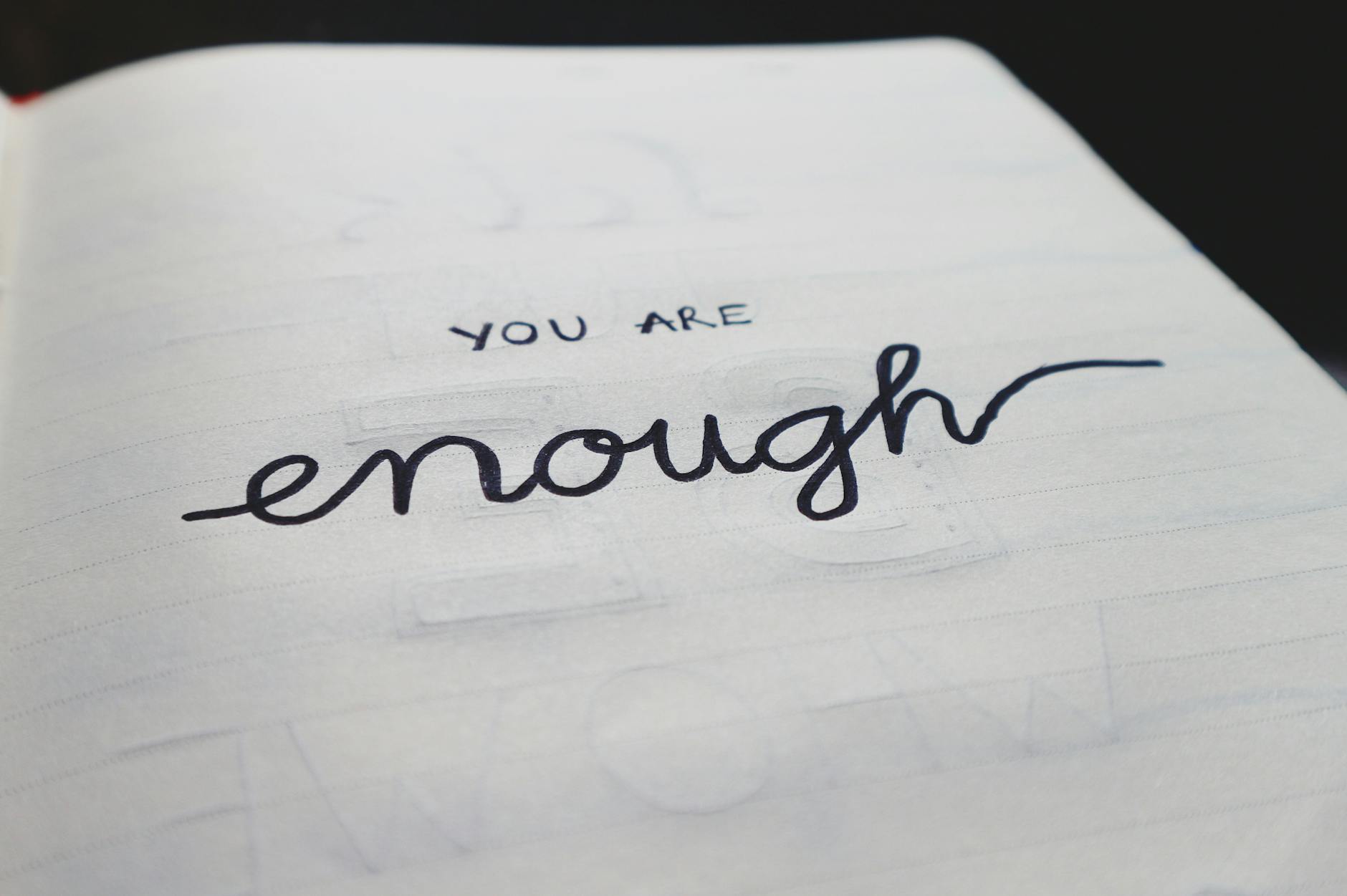
A close-up of a handwritten note that says 'You are enough' on a lined notebook page.
Photo by Bich Tran on Pexels.com

Learning to Be “Good Enough” on Purpose

For many people with high-functioning anxiety, healing doesn’t come from trying harder—it comes from intentionally doing less.

This can include:

  • Allowing small mistakes
  • Letting yourself under-perform occasionally
  • Resisting the urge to always max out
  • Practicing being uncomfortable without fixing it

This isn’t about lowering standards—it’s about increasing flexibility.

In therapeutic work, this often looks like a form of exposure:

learning to tolerate imperfection and uncertainty so your nervous system can finally stand down.

The Goal Isn’t Less Success—It’s More Presence

A hiker standing atop a rocky peak with arms outstretched, basking in the sunlight against a scenic mountain backdrop.

Reducing high-functioning anxiety doesn’t mean giving up ambition.

It means creating space to:

  1. enjoy what you’ve already built
  2. feel present in your life
  3. experience satisfaction without immediately chasing the next goal
  4. increase self-esteem or self worthiness

Burnout is not a personal failure.

It’s often a signal that the system you’ve been using no longer serves you.

A Gentle Next Step

If this resonates, you’re not broken—and you’re not alone.

You don’t have to wait until everything collapses to get support.

Learning to relate differently to achievement, pressure, and self-worth can restore energy, presence, and a sense of ease that anxiety quietly steals.

When Things Don’t Make Sense: Our Brain’s War on Randomness

Our brains hate randomness.

They’re wired to make sense of things — to find patterns, explanations, and stories that help us feel safe in an unpredictable world. This instinct isn’t a flaw; it’s evolutionary design. Detecting patterns once helped us survive — to predict danger, find food, or spot threats before they happened. But in modern life, that same mechanism can backfire.

When things feel uncertain or chaotic, we start to search for meaning everywhere. We try to explain every silence, every coincidence, every delay. For those of us with perfectionistic or obsessive tendencies, this drive for control can become relentless. We organize, analyze, and overthink in an effort to turn the unpredictable into something we can manage. OCD, in many ways, is this process in overdrive — a mind trying to create order where none exists.

The irony is that our brains are not particularly good scientists. They make connections based on incomplete data, filling in gaps to maintain a sense of coherence. Psychology identifies these as cognitive distortions: such as confirmation bias, personalization, all-or-nothing thinking — mental shortcuts that make the random feel meaningful. These patterns can help us feel more in control, but they often lead us away from truth and toward anxiety.

Sometimes, things really are just random.

The person who gave you a dirty look.

The friend who didn’t text back.

The awkward silence.

The string of bad luck that makes you feel cursed.

Maybe none of it means anything. And that’s difficult for the mind to accept.

Accepting randomness challenges one of our deepest needs: the need for control and create predictability. Yet learning to tolerate uncertainty — what psychologists call uncertainty tolerance — is central to emotional health. When we stop demanding that every event carry meaning, we make room for peace and perspective.

So next time your mind rushes to interpret, pause.

Take a breath.

Ask yourself: What if this is just random?

You might find that letting go of the need to make sense of everything is, in itself, a kind of freedom.

Free Speech: Your Power Is in Your Reaction

If we wish to preserve the First Amendment, we must amend our behavior.

Free speech is not the right to say whatever we want without consequence. It is the right for others to say what they want — and our responsibility to accept that reality. Acceptance is not agreement. Acceptance is not encouragement. It is simply the willingness to let words exist, even when we despise them.

Unconditional acceptance means I can acknowledge that people behave like flawed ignoramuses — not because I support ignorance, but because people are innately fallible, fucked-up human beings.

Here’s the truth: I cannot say whatever I want without repercussions, especially in the world of 2025 social media. My livelihood, my relationships, even my reputation can all be affected by what I say. So in practice, “free speech” lives not in the speaker, but in the reactor.

And yet today, it feels like everyone is pointing fingers — the extremist on my left blames the extremist on my right, and the extremist on my right blames the extremist on my left. Each side claims they are defending free speech while really just trying to silence their enemy. But free speech doesn’t die from what they say. It dies from how we react.

That means free speech isn’t preserved by canceling others, rallying outrage mobs, or gathering our proverbial pitchforks against those who hurt our feelings. That instinct to punish or silence only makes speech more fragile. Stop demanding censorship, start managing your own reactions.

If I want to preserve free speech, my civil duty is to control my response to ignorance, inflammatory rhetoric, and fearmongering. I may dislike it. I may be deeply offended by it. But I can accept its existence, because without that acceptance, I undermine the very freedom I claim to defend.

Freedom is not in demanding the right to say everything you wish. Freedom is in choosing how you respond to others. That is where your real power lies.

Take it back

Accountability as a Path to Growth

Human psychology exists for the purpose of survival. Much of what we do—consciously or unconsciously—stems from the instinct to protect ourselves. This can often show up in unpleasant ways such as selfishness, defensiveness, or even narcissism. This is because we cling to our sense of self, avoid shame, and fight to maintain control. When someone holds us accountable, or offers constructive feedback, it feels like a direct threat. This feedback threatens our fragile survival system.

But what if feedback isn’t a threat at all? What if it’s the very thing that helps us move closer to who we want to be?

Reframing Criticism

Most of us have been conditioned to see accountability as punitive – a consequence for getting “caught” doing something wrong. That mindset might work comfortably when it’s holding others accountable, but when the focus shifts to us, it triggers defensiveness, denial, or blame-shifting.

At its core, though, constructive feedback can be a mirror. It reflects how our actions affect others, reveals our blind spots, and increases self-awareness. Instead of viewing criticism as an attack, we can see accountability as an invitation- an opportunity to self-actualize. When we move from fear to receptiveness, feedback stops feeling like a strike against our worth and becomes a compass guiding us in a better direction.

From “Fuck You” to “Thank You”

Imagine a culture where feedback isn’t met with hostility but with gratitude. Instead of a reflexive “fuck you” when we’re challenged, we respond with “thank you.”

Thank you for helping me see what I couldn’t.

Thank you for trusting me enough to call me to corrective action.

Thank you for letting me know where you stand so I can properly adapt.

That small shift can have profound effects. It builds trust in relationships, strengthens communities, and creates workplaces and families where honesty isn’t feared but welcomed. Accountability stops being a weapon and becomes a gift when we reframe it.

Choosing Growth Over Defense

This isn’t easy. Our instinct to protect ourselves won’t disappear overnight. But each time we catch ourselves getting defensive, we have a choice: double down on pride, or lean into growth. The latter requires humility, vulnerability, and courage. Yet it also leads to freedom—the freedom that comes from knowing we don’t have to be perfect, only willing to learn.

Unconditional self acceptance is the foundation of this work. Only when we accept ourselves fully can we acknowledge our mistakes and embrace feedback without shame.

If we, collectively, begin to approach accountability this way, we will change not just our individual lives but the culture we live in. A culture less obsessed with defending the ego and more committed to becoming better, together.

So the next time someone calls you out—or calls you in—pause. Breathe. And maybe, just maybe, try saying “thank you.” This week, let’s choose one phrase as our accountability anchor. Use something like “Thank you, I’ll have to think about that.” Carry it with you. Practice using it the next time feedback comes your way.