Behavioral Activation: Acting Despite Our Feelings

A male runner wearing a red athletic outfit and number 1950, sprinting on a dry, cracked landscape with a cloudy sky.

People often assume that “feeling better” come before doing better. We tell ourselves:

  • “I feel too anxious to go out.”
  • “I don’t feel motivated enough to exercise.”
  • “I’m too depressed (or negative) to be around others.”

Unfortunately, this approach strengthens our our negative emotions. It rarely works to wait for the emotional change to occur organically. Waiting to feel right usually means waiting indefinitely.

As much as our feelings (and thoughts) can affect our behavior; a core principle of psychology is that our behaviors can also directly affect our feelings. It’s an interactive relationship.

Behavioral activation, is a well-established psychological approach, that relies on the latter principle:

Action often precedes emotional change. We gradually increase our sense of capability as we take more action. We can rewire our perspective on the desired tasks. Instead of I can’t do this, I’m not feeling it: It’s I did this even though I wasn’t feeling it.

The Decision-Making Problem

In therapy, people frequently explain their behavior through their feelings.

  • “I didn’t go to the event because I was anxious.”
  • “I stayed in bed because I was too depressed.”
  • “I said that because I was angry.”

The reasoning feels intuitive.

But it creates a predictable cycle.

  • – Avoiding anxiety strengthens anxiety.
  • – Withdrawing from others reinforces depression.
  • – Reacting in anger escalates conflict.

When behavior is consistently organized around emotions, those emotions can grow stronger rather than weaker.

The Order of Operations

Part of the issue is what I often describe as a reversed order of operations.

Many people live according to this sequence:

Feel → Act → Think

An emotion appears.

Behavior follows quickly.

Reflection happens afterward and usually with disappointment or regret.

This pattern tends to produce impulsive decisions, avoidance, and reinforce a lack of motivation.

A more effective sequence looks different:

Stop → Think → Act → Feel

Pause.

Consider your values or long-term goals.

Decide what would be the preferred way of acting. Then do it regardless. Even if you don’t like it or feel sub-optimal, it’s allowing for your emotional state to adjust over time. The feeling does not need to change first. The behavior does.

Acting Despite How You Feel

Behavioral activation is not about ignoring emotions.

It’s about not allowing them to dictate behavior.

For example:

  • “I went to the event despite feeling anxious.”
  • “I went to the gym despite feeling unmotivated.”
  • “I didn’t react despite feeling angry.”

None of these choices guarantee an immediate improvement in mood.

But they create room for change.

Avoidance almost guarantees the feelings continue and nothing improves.

Action at least allows improvement to occur.

Why Behavior Changes Emotion

Emotions are influenced heavily by behavior and environment.

When someone withdraws, avoids, or reacts impulsively, the environment tends to confirm the original feeling.

  • Isolation reinforces depression.
  • Avoidance reinforces anxiety.
  • Conflict reinforces anger.

When behavior changes, the environment often changes as well.

New experiences create opportunities for different emotional outcomes.

Feelings Are Valid — But Not Always Useful

Acknowledging emotions is important. But it doesn’t mean feelings always win. Feeling are not always helpful for making decisions, partly because they are not always accurate.

They provide information, not necessarily direction. The feeling can be a response to a problem but it isn’t the solution.

In many situations, the most productive approach is simple:

Act according to your values, not according to your temporary emotional state. Start with identifying those values and the version of yourself you would like to be.

The positive feelings will follow.

When Behavioral Activation Helps Most

Behavioral activation is particularly helpful for:

The common theme is the same:

behavior shrinks while negative emotions expand.

Reversing that pattern is where change begins.

An Actionable Step

The next time a difficult feeling appears, pause and ask one of these questions:

“If I were feeling better, what would I do?”

“How will I feel afterwards?”

“What would success look like?”

Then try doing the behavior that most aligns with your answer.

Not because you feel like it.

But despite how you feel.

High-Functioning Anxiety: Identifying Burnout Early

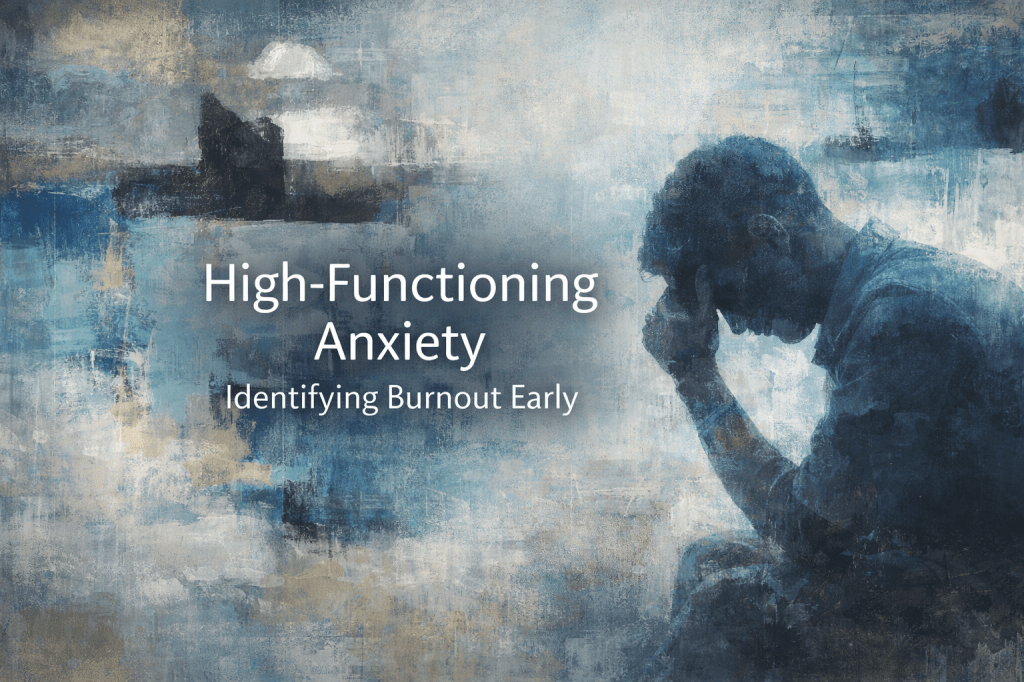
An abstract image depicting a person in a thoughtful pose, symbolizing high-functioning anxiety and burnout, with a blue and grey color palette. The text overlay reads 'High-Functioning Anxiety' and 'Identifying Burnout Early.'

High-functioning anxiety often goes unnoticed—not because it isn’t painful, but because it works.

From the outside, it can look like success. Competence. Leadership. Reliability.

On the inside, it often feels like never being able to fully exhale.

Many people with high-functioning anxiety don’t realize they’re burning out until their nervous system forces a stop.

What High-Functioning Anxiety Can Look Like

A close-up of a young businessman with blue eyes and styled hair, looking serious in an office setting, with a blurred figure in the background holding a document.

High-functioning anxiety doesn’t always show up as panic or avoidance. More often, it shows up as traits that are rewarded.

  • Reliability: Always following through. Always doing what you said you would do—often driven by internal pressure, perfectionism, or fear of letting others down.
  • Productivity: A strong need to prove yourself. Seeking reassurance through achievement, output, or external validation.
  • Leadership Skills: Being highly attuned to other people’s needs, moods, and expectations—sometimes at the expense of your own.
  • Problem-Solving: Constantly scanning the environment for potential issues or threats. Always thinking ahead. Always preparing.

These traits can lead to professional or financial success. This is why it’s so hard to identify them and reduce them when needed.

When Functioning Turns Into Exhaustion

Over time, this way of operating takes a toll.

High-functioning anxiety often leads to burnout marked by:

  • Always having to be on.
  • Difficulty enjoying success because you’re focused on preserving it.
  • Impostor syndrome—worrying you’ll be “found out”
  • Future-tripping instead of being present
  • A persistent lack of joy, satisfaction, or ease
  • Rarely stopping to enjoy what you’ve already achieved

You may technically be doing well—yet feel disconnected, restless, or chronically tired.

Why Letting Go Feels So Hard

One of the biggest challenges with high-functioning anxiety is that the anxiety has worked.

It may have helped you:

  • reach goals
  • advance your career
  • create stability
  • earn respect

So the idea of loosening control can feel dangerous.

Many people worry:

“If I stop pushing myself, everything will fall apart.”

From Demands to Preferences

A key shift in reducing burnout and perfectionism is learning to move from demanding thinking to preference-based thinking. We identify demand thinking with buzz words like: should, have to, or must.

Demanding thoughts sound like:

I must succeed to justify my position in life.

I have to hit this metric to prove my worth.

I should be doing more or I am going to fail.

Preference-based thoughts sound like:

I prefer to succeed. (I do not have to succeed in all aspects of my life to be valuable)

I’d like to hit this metric. (I can adapt if I don’t hit each metric for each task. I don’t have to prove my worth)

I want to achieve this goal. (I can accept if I don’t achieve goals exactly when I want. Failure is not fatal)

The difference matters.

When goals become demands, your worth gets tied to outcomes.

When goals remain preferences, effort and value can coexist—even when things don’t go ideally.

Your worth does not increase when you achieve more, and it does not disappear when you fall short.
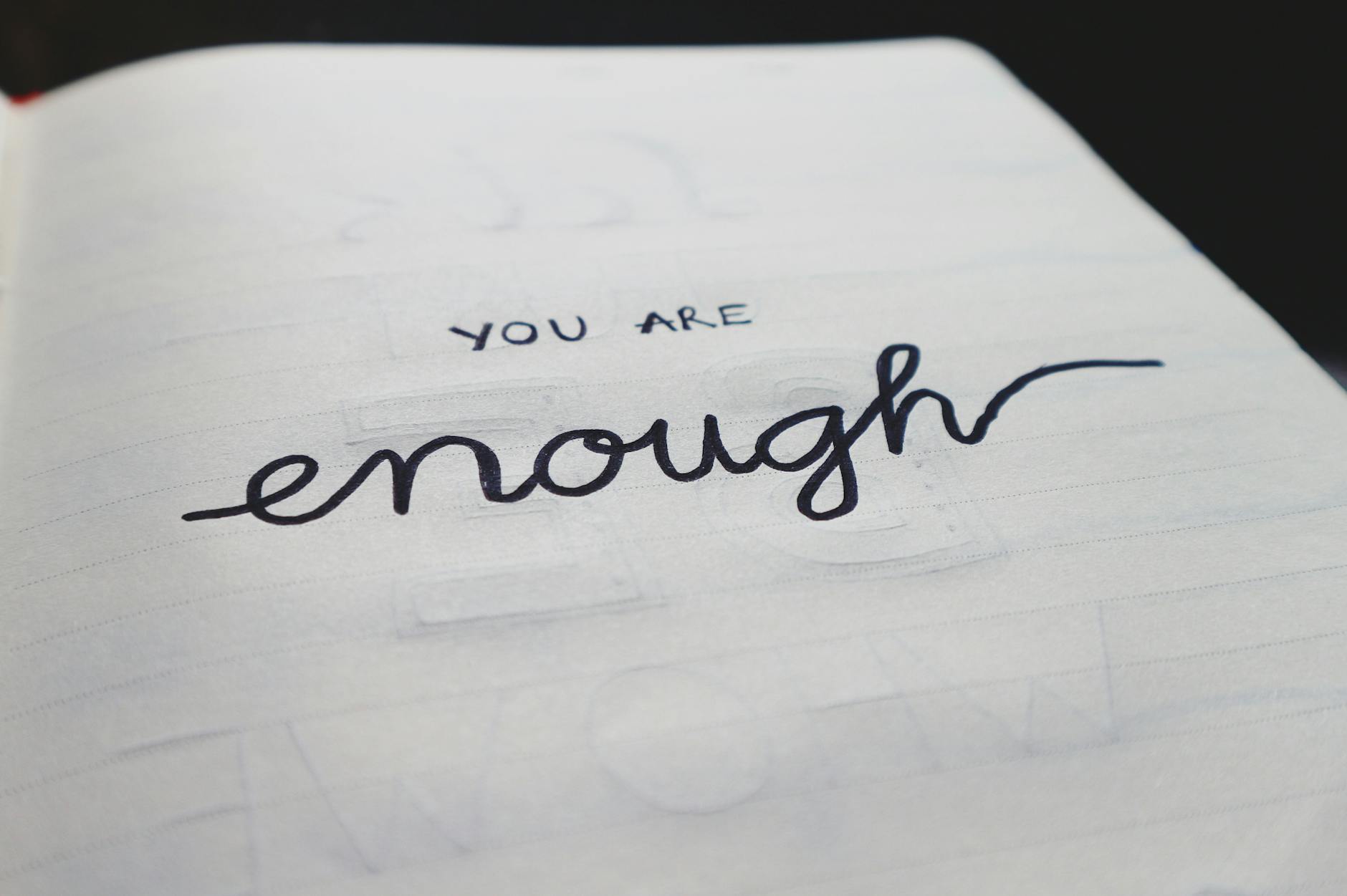
A close-up of a handwritten note that says 'You are enough' on a lined notebook page.
Photo by Bich Tran on Pexels.com

Learning to Be “Good Enough” on Purpose

For many people with high-functioning anxiety, healing doesn’t come from trying harder—it comes from intentionally doing less.

This can include:

  • Allowing small mistakes
  • Letting yourself under-perform occasionally
  • Resisting the urge to always max out
  • Practicing being uncomfortable without fixing it

This isn’t about lowering standards—it’s about increasing flexibility.

In therapeutic work, this often looks like a form of exposure:

learning to tolerate imperfection and uncertainty so your nervous system can finally stand down.

The Goal Isn’t Less Success—It’s More Presence

A hiker standing atop a rocky peak with arms outstretched, basking in the sunlight against a scenic mountain backdrop.

Reducing high-functioning anxiety doesn’t mean giving up ambition.

It means creating space to:

  1. enjoy what you’ve already built
  2. feel present in your life
  3. experience satisfaction without immediately chasing the next goal
  4. increase self-esteem or self worthiness

Burnout is not a personal failure.

It’s often a signal that the system you’ve been using no longer serves you.

A Gentle Next Step

If this resonates, you’re not broken—and you’re not alone.

You don’t have to wait until everything collapses to get support.

Learning to relate differently to achievement, pressure, and self-worth can restore energy, presence, and a sense of ease that anxiety quietly steals.