My Top 3 Irrational Beliefs

The real B.S. I used to tell myself—and believed for longer than I care to admit.

As a cognitive behavioral psychotherapist, I spend a lot of time helping people identify irrational beliefs.

Very often the stories we tell ourselves and the assumptions we make are flawed or self limiting. We reach conclusions and fill in gaps without much evidence.

We subjectively create rules for ourselves that, at some point, we stop questioning.

Unfortunately for me, being a psychotherapist does not make me immune to any of this.

I have my own irrational beliefs. Some which I’ve stubbornly held onto for years. And the tricky thing about an irrational belief is that when you believe it, it usually doesn’t sound irrational.

It sounds completely reasonable to us at the time.

So in an effort at transparency and vulnerability, here are three of mine.

Irrational Belief #1: “I’m a psychotherapist. I shouldn’t be in great physical shape.”

For a long time, I had this strange belief about being physically fit. I told myself I didn’t need to be in great shape because I was a psychotherapist. Part of that was probably just a convenient excuse to do bare minimums.

But there was something else underneath it.

I thought being too physically fit might actually make me less relatable. Maybe people would look at me and wonder what I was trying to prove. Maybe they’d think I was hiding something.

Maybe a client struggling with their own health, motivation, confidence, or body image would look at me and think:

He doesn’t get it.

So somehow I turned not taking care of myself into something that felt almost professionally responsible.

That was my own B.S.

The reframe was much simpler:

I can care about my physical health and appearance because I care about me.

It doesn’t have to have anything to do with other people:

A) I can exercise because I like feeling strong.

B.). I can care about how I look because it makes me feel more confident.

C.) By challenging myself physically it reminds me I can do difficult things.

And none of those things make me less capable of understanding someone else’s struggle. If anything, what actually happens is the exact opposite of what I feared. I’m more confident and speak with more conviction in my approach. Theres more heart. I genuinely feel better.

My behavior is more congruent with a lot of the things I encourage in therapy.

And I think my clients benefit from that.

Irrational Belief #2: “If my clients find out I’m divorced, they’ll see it as negative.”

For years, I was extremely cautious about self-disclosure.

I’m a therapist. The session isn’t about me. I need to have strong boundaries. And these are good reasons to have boundaries around what and how much we share with clients. But somewhere along the way, healthy boundaries turned into boxed in walls. Based on fear or my own anxiety.

I worried that if clients knew too much about me, eventually something could be used against me.

Divorce was a big one.

He got divorced.

His marriage failed.

What does he know about successful relationships?

So I kept parts of myself hidden for far too long. Not necessarily because keeping them private made me a better therapist, but because keeping them private made me feel safer.

Eventually, I had to dispute that self serving by self limiting comfort zone.

I can have appropriate boundaries without being afraid of being known.

I can be proud of choosing divorce even if someone else sees it as failure.

I survived something difficult.

I made a decision that was healthier for me and gave me more opportunity to be the father I wanted to be.

And none of that disqualifies me from helping someone else navigate their relationships.

What actually happened?

I became more comfortable acknowledging my failures.

I became more intentional with self-disclosure instead of simply being afraid of it. (Also, no one used my divorce against me. It actually is more of a gateway into understanding people)

More importantly, I stopped believing that being a good therapist required presenting some carefully protected version of myself.

I can have boundaries.

I can keep parts of my life private.

But I don’t have to hide myself out of fear.

Irrational Belief #3: “Posting on social media to get clients is for therapists who need clients.”

This one is probably the most humbling to admit because I didn’t just avoid social media.

I judged other therapists for doing it.

I thought it was cringey.

There was this part of me that believed:

Just be good at your craft.

If you’re a good therapist, people will find you.

You shouldn’t have to shamelessly promote yourself.

And if you’re constantly posting online trying to get clients, maybe that says something about your ability as a therapist.

Then eventually I had to confront something uncomfortable.

I wasn’t avoiding social media because I had some deeply held professional principle.

I was boxing myself in because I cared too much about other people’s opinions.

What if another therapist thinks I’m cringey?

What if someone thinks I’m desperate for clients?

What if people I know see one of my videos and make fun of me?

I was allowing hypothetical opinions from hypothetical people to dictate what I was willing to try.

That isn’t freedom. It’s confinement.

The reframe became:

I don’t need to do this to still do it and enjoy it.

In fact, maybe it’s better to start doing something before you need it.

And what actually happened?

It’s fun.

I enjoy writing.

I enjoy making videos.

I enjoy trying to communicate psychological ideas in ways that people might actually want to read or watch.

I’ve realized that actively creating on social media feels a lot better to me than lurking as a passive recipient of overstimulation.

I’ve connected with people I otherwise wouldn’t have.

I’ve created more.

I’ve written more.

And yeah, I may have even gained a client or two.

They Were All the Same Irrational Belief

At first glance, these are three completely different beliefs.

One is about physical fitness.

One is about divorce.

One is about social media.

But when I started looking at them together, I realized they were really just different versions of the same irrational belief:

Other people’s hypothetical opinions should influence how I live my actual life.

That one had a lot more control over me than I realized.

And disputing it doesn’t mean I’ve convinced myself that nobody will judge me.

That’s just another irrational belief.

Someone might think I care too much about how I look.

Someone might think a divorced therapist has no business talking about relationships.

Someone might watch one of my videos and think I’m cringey.

Someone might read this entire blog post and think the same thing.

That’s possible.

The healthier belief isn’t:

Nobody will judge me.

It’s:

I can withstand it if and when they do.

I don’t have to organize my life around preventing negatives. I can adapt and overcome them.

Empathy or Enabling? Know your limits.

Remove all text near people

Empathy is essential for human connection. It allows us to understand and support each other. It’s important to validate the emotional experiences of others in order to strengthen are most meaningful relationships. So at its core, empathy is necessary for healthy relationships

But empathy also has a limit. It’s not an endless resource.

It can take a lot out of us. Especially when it goes beyond understanding and into over-involvement, codependency, or enmeshment. Empathy to the Nth degree can begin to work against the very growth it’s meant to support.

A Spectrum of Empathy

Like most nuanced psychological principles – it can be most helpful to think of empathy as existing on a spectrum. Not all or nothing. Not binary. But with shades of grey

On one end, we often criticize and distance ourselves from those who lack empathy. Seeing the existence of empathy as an automatic positive.

Which empathy can be when grounded and with appropriate boundaries. This balanced or healthy empathy allow us to recognize someone else’s emotional experience without taking it on as our responsibility. This form of empathy supports both connection and autonomy. This is “true empathy” that is consistent with emotional intelligence.

When Empathy Becomes Self-Focused

However, for some as empathy intensifies, it can shift from selfless to selfish. We may begin to feel not only with someone, but for them to the point that their discomfort becomes difficult for the empathizer to tolerate.

At this far end of the spectrum, empathy becomes enabling when the empathizer finds themselves desperately trying to remove the discomfort from the other person. This happens when we claim to feel so badly for someone else that we no longer want them to feel it. But removing someone else’s opportunity for an emotional response, (including negative emotions) no matter how well intentioned is ultimately self serving.

This becomes limiting for one party and burdensome for the other. Instead of being about the other person’s experience, it becomes about the empathizers discomfort with their experience.

If we step in, fix, soften, or carry the emotional weight— we are not helping them, but relieving what we are feeling in response to it.

In that sense, empathy that has exceeded its limit can become more self-focused than it appears.

Why This Matters

Emotional discomfort plays an important role in growth.

Feelings like frustration, regret, or sadness are not problems to be eliminated—they are part of how people learn, adapt, and develop resilience.

When we consistently remove or absorb that discomfort for others, we may unintentionally limit their ability to build those skills.

Support does not require removing the experience. It requires allowing space for it.

Differentiating the Difference

A useful distinction is this:

  • Empathy says: “I see you and understand what you’re feeling.”
  • Enabling says: “I’ll take this from you so you don’t have to feel it.”

The difference is not in how much we care, but in how we respond to that care.

Conclusion

Empathy is not the problem. In fact, it’s necessary.

But when it goes beyond a healthy limit—when it shifts from understanding to over-carrying—it can become counterproductive.

You can care deeply about someone
without carrying what is theirs to feel.

That balance is where empathy is most effective.

A motivational quote over a background of burning firewood that reads: 'you are not required to set yourself on fire to keep other people warm.'
Three people playing basketball and laughing on an outdoor court at sunset

Fun Isn’t Frivolous: It’s Fuel for Life

Three people playing basketball and laughing on an outdoor court at sunset

Lately I’ve been thinking a lot about fun We love it and yet we are not having enough of it.

We are often entertained. Frequently wanting a distraction. Planning future events. But not let ourselves have real fun in the moment.

Somewhere along the way, too many of us lose touch with it. I hypothesis it starts in teenage years when we start feeling societal pressure and demands. We slow start taking life too seriously. Then in adulthood we gradually add responsibilities and start prioritizing productivity, milestones, achievement, and earnings. We treat fun like a reward we earn after handling our responsibilities.

The problem is… life is a series of problems. So the responsibilities are never fully handled.

There will always be another email, another call, another task, another goal, another pressure, and another metric. If we try fun as future priority we won’t have it. “I’ll be happy when… turns into I can’t be happy now”

Anxiety Might Push You. Fun Sustains You.

As a psychotherapist who works with perfectionism and overthinking, I see a lot of performance-based anxiety.

The pressure to succeed.
The pressure to do more.
The pressure to always be improving.

And to be fair, anxiety can be useful in the short term.

A lot of high achievers are productive because of anxiety. It helps them stay sharp, stay driven, stay on top of things.

But the issue is sustainability.

You can absolutely build success through pressure.
You just usually can’t hold onto it for too long.

That’s where fun comes in.

Fun prevents burnout.
Fun reinvigorates us.
Fun pulls us out of performance mode and back into the present moment.

So even if anxiety pushes us towards success initially- fun is what can help keep us succesful .

Life Was Never Meant to Be Only Outcomes

When you listen to your favorite song, it isn’t about getting to the end of the song.

It’s about singing along. Maybe dancing badly in your kitchen with your loved ones.

When you play sports or board games with your kids, it isn’t about finishing the game.

It’s about playing – the laughing, bonding, harmless competition, and creating memories.

When you go on vacation, it sure as hell isn’t about get back home. It’s not completing the trip.

It’s enjoy it. Having fun along the journey.

Somewhere along the way, many adults start treating life like one giant checklist. Finish the task. Reach the milestone. Get to the next thing.

But life was never meant to only be completed.

It was meant to be lived.

What Is “True Fun”?

We all know what fun is in theory. But I think it helps to define it more clearly.

True fun usually includes three things:

1. Playfulness

Not taking everything so seriously. Room for humor, silliness, spontaneity.

2. Flow

Being immersed enough in the moment that you forget your to-do list for a while.

3. Connection

Sharing moments, laughter, energy, or meaning with others.

That might look like:

  • Playing ping pong and laughing at the ridiculous points in between keeping score
  • Singing karaoke in the kitchen and forgetting what day it is
  • Sitting at dinner with family, recapping the day and joking around
  • Shooting hoops with no agenda other than enjoying yourself
  • Going for a walk and actually noticing the day

Fun often sounds small. But its impact is not small.

Fun Helps Mental Health

Fun is not a cure for anxiety or depression.

But it can be a powerful part of healing.

Fun can help us reconnect with ourselves.
It can remind us we are more than our stress.
It can increase willingness to participate in life again.
It can restore confidence, connection, and energy.

Sometimes people think mental health is only about deep work, heavy conversations, fixing problems.

That matters too.

But healing also happens in laughter.
In movement.
In shared moments.
In joy that doesn’t need to be earned.

This Week, Try This

Don’t ask only:

“What do I need to get done?”

Also ask:

“What can I do to make this day more fun?”

That question can change more than people realize.

Because fun isn’t childish.
It isn’t lazy.
It isn’t extra.

Fun is often the thing that makes life feel like life again.

Stop Trying to Optimize Your Life (And Why Self-Optimization Fuels Anxiety)

There’s nothing inherently wrong with wanting to improve your life.

The problem isn’t improvement. The problem is when improvement becomes a requirement or psychological demand for self-worth. Furthermore if we must always be constantly improving we leave no room for acceptance.

Bettering yourself is great. Telling yourself your not enough isn’t okay.

When Optimization Turns Into Pressure

We are living in a culture that encourages constant optimization.

Track your sleep.

Dial in your macros.

Engineer your morning routine.

Regulate your nervous system.

Maximize your potential.

None of this is pathological on its own.

But from a cognitive-behavioral perspective, distress is rarely caused by habits themselves. It’s caused by the beliefs attached to them.

When the belief becomes:

  • “If I’m not consistent, I’m failing.”
  • “If I can’t regulate my anxiety 100%, something is wrong with me.”
  • “If I’m not maximizing my potential, I’m wasting my life.”

We’ve crossed from growth into conditional self-esteem.

And conditional self-esteem is fragile. If self-worth is earned; it can be taken away.

Perfectionism in a More Sophisticated Form

Most people misunderstand perfectionism.

It’s not simply high standards.

It’s the belief that your value depends on performance.

That belief is strongly associated with:

Optimization culture often reinforces this pattern quietly.

It suggests that if you just refine the habits enough — sleep better, eat better, regulate better, focus better — you’ll finally feel like your enough.

But if your stability depends on perfect execution, you won’t feel stable for very long. Even if you capture it on one random occasion; then what? Are you required to replicated the performance indefinitely in order to maintain your worth?

That’s self-disturbing pressure, not self-actualization.

The Psychological Mechanism

Clinically, what we often see is rigidity.

Rigidity looks like:

  • Low tolerance for deviation
  • Intolerance of uncertainty
  • Excessive self-monitoring
  • Global self-judgment after minor mistakes
  • Negative self-rating

Missing one workout becomes evidence of inadequacy.

A bad night of sleep becomes a link to some personal failure.

An anxious day becomes proof that you’re not “cured.”

The behavior isn’t the issue.

The interpretation is.

This is a core principle in CBT and REBT: emotional distress is amplified by rigid, absolutistic beliefs — not by imperfection itself.

Control Is Not the Same as Health

Many optimization strategies are attempts to reduce discomfort through control.

Control can be useful.

But when control becomes an obsessive need to avoid feeling inadequate, anxious, or uncertain, it reinforces the very vulnerability it’s trying to eliminate.

The more you try to eliminate anxiety completely, the more sensitive you become to it.

The more you try to eliminate imperfection, the less resilient you become to normal human fluctuation.

Without acceptance, self-improvement becomes anxiety with better branding.

Unconditional Self-Esteem

Healthy discipline is compatible with unconditional self-worth.

Unhealthy discipline depends on conditional self-worth.

The difference is subtle but clinically important.

Unconditional self-esteem says:

I have inherent value as a human being. I can prefer to perform well, but my value is not dependent on it.

Conditional self-worth says:

I must perform well to justify my value.

The second creates chronic internal pressure.

The first creates cognitive flexibility.

And flexibility is what predicts long-term mental health.

A More Sustainable Model

Mental health is not optimal regulation.

It is psychological flexibility.

It is the ability to:

  • Miss a workout without collapsing your identity
  • Feel anxious without interpreting it as failure
  • Be inconsistent without becoming self-condemning
  • Improve without needing improvement to feel acceptable

Fixated attempts to optimize your life are often sub-optimal for your mental health.

Because they quietly reinforce the equation:

Performance = Value.

And that equation fuels anxiety.

Final Thought

You don’t need to abandon self-improvement. You need self-acceptance while doing it.

You need to loosen your attachment to optimization.

If your self-worth is stable, improvement becomes preferential.

Preferential thinking is sustainable.

Compulsive optimization (absolute thinking) is not.

High-Functioning Anxiety: Identifying Burnout Early

An abstract image depicting a person in a thoughtful pose, symbolizing high-functioning anxiety and burnout, with a blue and grey color palette. The text overlay reads 'High-Functioning Anxiety' and 'Identifying Burnout Early.'

High-functioning anxiety often goes unnoticed—not because it isn’t painful, but because it works.

From the outside, it can look like success. Competence. Leadership. Reliability.

On the inside, it often feels like never being able to fully exhale.

Many people with high-functioning anxiety don’t realize they’re burning out until their nervous system forces a stop.

What High-Functioning Anxiety Can Look Like

A close-up of a young businessman with blue eyes and styled hair, looking serious in an office setting, with a blurred figure in the background holding a document.

High-functioning anxiety doesn’t always show up as panic or avoidance. More often, it shows up as traits that are rewarded.

  • Reliability: Always following through. Always doing what you said you would do—often driven by internal pressure, perfectionism, or fear of letting others down.
  • Productivity: A strong need to prove yourself. Seeking reassurance through achievement, output, or external validation.
  • Leadership Skills: Being highly attuned to other people’s needs, moods, and expectations—sometimes at the expense of your own.
  • Problem-Solving: Constantly scanning the environment for potential issues or threats. Always thinking ahead. Always preparing.

These traits can lead to professional or financial success. This is why it’s so hard to identify them and reduce them when needed.

When Functioning Turns Into Exhaustion

Over time, this way of operating takes a toll.

High-functioning anxiety often leads to burnout marked by:

  • Always having to be on.
  • Difficulty enjoying success because you’re focused on preserving it.
  • Impostor syndrome—worrying you’ll be “found out”
  • Future-tripping instead of being present
  • A persistent lack of joy, satisfaction, or ease
  • Rarely stopping to enjoy what you’ve already achieved

You may technically be doing well—yet feel disconnected, restless, or chronically tired.

Why Letting Go Feels So Hard

One of the biggest challenges with high-functioning anxiety is that the anxiety has worked.

It may have helped you:

  • reach goals
  • advance your career
  • create stability
  • earn respect

So the idea of loosening control can feel dangerous.

Many people worry:

“If I stop pushing myself, everything will fall apart.”

From Demands to Preferences

A key shift in reducing burnout and perfectionism is learning to move from demanding thinking to preference-based thinking. We identify demand thinking with buzz words like: should, have to, or must.

Demanding thoughts sound like:

I must succeed to justify my position in life.

I have to hit this metric to prove my worth.

I should be doing more or I am going to fail.

Preference-based thoughts sound like:

I prefer to succeed. (I do not have to succeed in all aspects of my life to be valuable)

I’d like to hit this metric. (I can adapt if I don’t hit each metric for each task. I don’t have to prove my worth)

I want to achieve this goal. (I can accept if I don’t achieve goals exactly when I want. Failure is not fatal)

The difference matters.

When goals become demands, your worth gets tied to outcomes.

When goals remain preferences, effort and value can coexist—even when things don’t go ideally.

Your worth does not increase when you achieve more, and it does not disappear when you fall short.

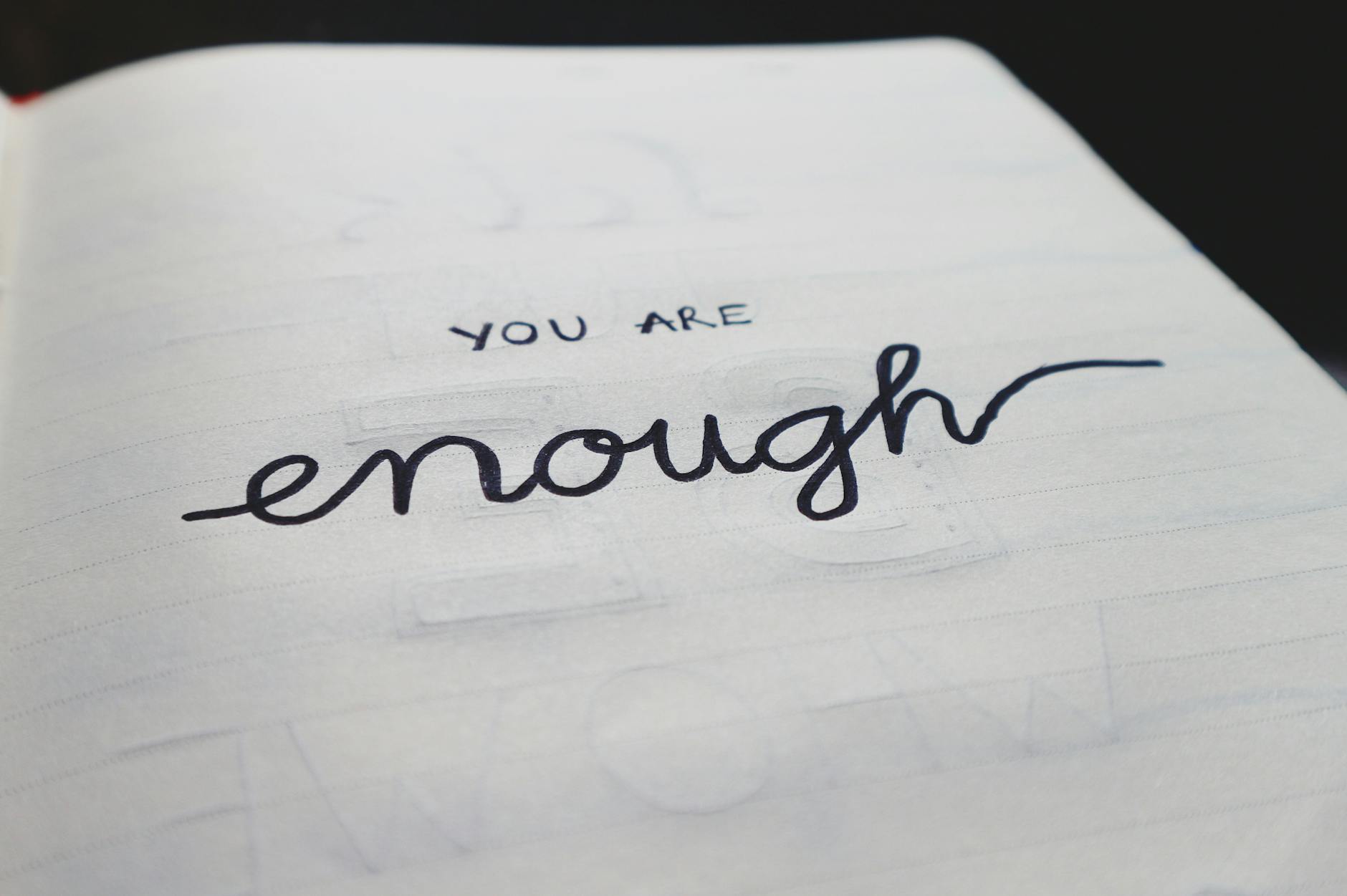
A close-up of a handwritten note that says 'You are enough' on a lined notebook page.
Photo by Bich Tran on Pexels.com

Learning to Be “Good Enough” on Purpose

For many people with high-functioning anxiety, healing doesn’t come from trying harder—it comes from intentionally doing less.

This can include:

  • Allowing small mistakes
  • Letting yourself under-perform occasionally
  • Resisting the urge to always max out
  • Practicing being uncomfortable without fixing it

This isn’t about lowering standards—it’s about increasing flexibility.

In therapeutic work, this often looks like a form of exposure:

learning to tolerate imperfection and uncertainty so your nervous system can finally stand down.

The Goal Isn’t Less Success—It’s More Presence

A hiker standing atop a rocky peak with arms outstretched, basking in the sunlight against a scenic mountain backdrop.

Reducing high-functioning anxiety doesn’t mean giving up ambition.

It means creating space to:

  1. enjoy what you’ve already built
  2. feel present in your life
  3. experience satisfaction without immediately chasing the next goal
  4. increase self-esteem or self worthiness

Burnout is not a personal failure.

It’s often a signal that the system you’ve been using no longer serves you.

A Gentle Next Step

If this resonates, you’re not broken—and you’re not alone.

You don’t have to wait until everything collapses to get support.

Learning to relate differently to achievement, pressure, and self-worth can restore energy, presence, and a sense of ease that anxiety quietly steals.