Parenting by Example: How Confidence is Modeled, Not Taught

At this stage of my career, I primarily work with young adults and adults navigating anxiety, depression, and self-esteem. But not that long ago, I was the young, cool therapist—the one parents wanted their ADHD or ODD sons to connect with.

I still love child development. I still enjoy working with kids and adolescents.

But nothing grounds you quite like having an 11-year-old daughter and a 13-year-old stepdaughter.

I am no longer the young, cool therapist. And almost certainly not the cool guy at home. (The eye rolls out number the laughs nowadays)

And honestly? That’s probably for the best.

When Being “Cool” Stops Being the Goal

Not that I’m trying to be cool to middle schoolers. Insert generic dad joke about not having rizz. (Listen, I’m cool enough to know not to even attempt it.)

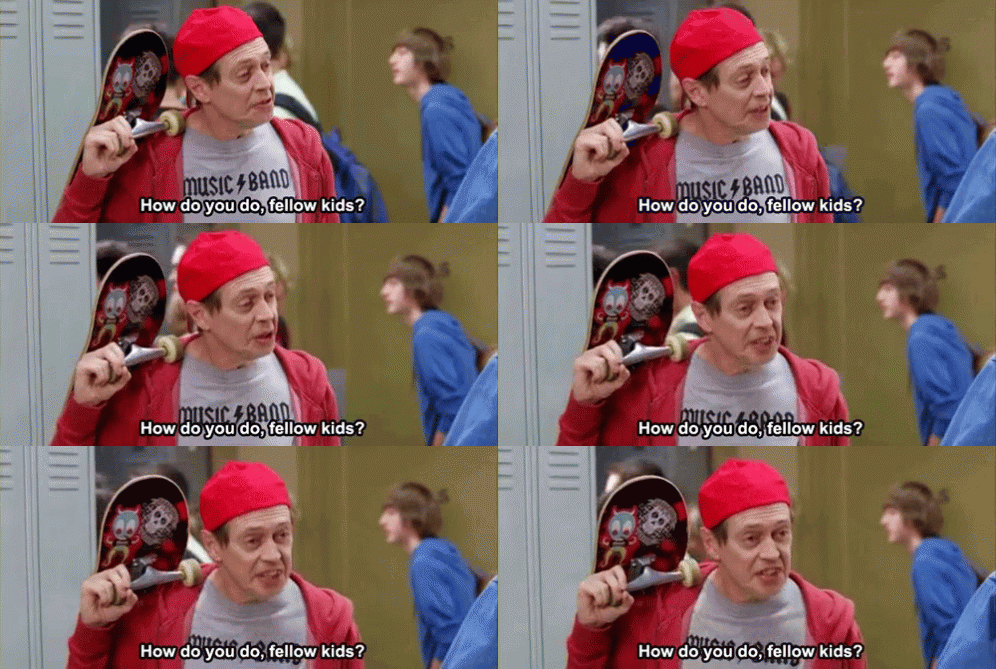
A man wearing a red cap and skateboard, dressed in casual attire, greets a group of young people with the phrase 'How do you do, fellow kids?'

What’s shifted isn’t my sense of humor—it’s my focus. Somewhere in the second decade of parenting, the question quietly changes. It’s no longer about telling them they’re awesome little achievers that can do anything they put their little minds to.

It becomes about showing them what it looks like to be proud of yourself in life.

Am I someone I’d want to become?

Am I leading by example?

The First Decade: Building Their Confidence and life. 

During the first decade of parenting, I spent a lot of energy cultivating my daughter’s self-esteem. I encouraged her and celebrated her achievements. I made sure she knew she was capable and worthy.

Lately?

She gives significantly fewer shits about what I think.

She rolls her eyes and sarcastically asks “is this another life lesson?!” She complains when I encourage her to be proud of herself. I get it. It’s dorky now. It’s parent stuff.

The Second Decade: Modeling Living a confident enjoyable life. 

What actually needs my attention now isn’t coaching her confidence—but modeling it.

That means being proud of myself.

Not “cool” (that ship sailed when I started making comments worthy of Progressive Insurance commercials).

But grounded. Intentional. Honest.

Sometimes I catch myself wondering:

Would my daughter want to live a life like mine?

Two individuals running on treadmills in a gym with large windows showing a view of the outdoors.

Leading by Example Isn’t About Control—It’s About Consistency

I hope my daughter continues to be her own independent, creative self. (Though, good or bad, she has many of my idiosyncrasies.)

My role now feels less about directing her growth and more about living in a way that demonstrates self-respect.

One of the best things we can do for the people we love is take care of ourselves. We are not do it performatively, not perfectly, but consistently.

Good parenting isn’t just being present and attentive.

It’s being able to stand behind the life you’re living.

That includes being proud of your own:

  1. Daily habits
  2. Physical health and movement
  3. Mental health and emotional regulation
  4. Relationships
  5. Interests, hobbies, and passions

Kids notice what we do far more than what we say.

A framed sign with the text 'SELF CARE ISN'T SELFISH' displayed against a pink background, accompanied by a shadow from a plant.

Modeling Matters More Than Motivating

Recently, our girls did wall sits for an absurd amount of time—because I was doing a wall-sit challenge at my gym.

No lecture required.

No motivational speech.

Just modeling.

My daughter has also been leaning into humor lately. (I like to think we’ve made her life just stressful enough to have good material, yet comfortable enough to feel secure being silly.)

She told me a story from school that stuck with me.

She wanted to leave school early. She Googled me, pulled up my website, and showed her friends my profile—where my session fees are listed.

She announced:

“Guys, I have to come up with at least a hundred dollars for my dad to come get me.”

I was proud—not because she was “flexing,” but because she was playful, confident, and comfortable sharing this tibdit with her classmates ( and now with me). She proceeded to ask her classmates if she looked like me. (She did not need confirmation—unfortunately- poor girl looks exactly like her dad.)

What that moment told me was this:

She wasn’t embarrassed by me.

She wasn’t hiding me.

She was proud.

A man in sunglasses stands with a water bottle and a towel over his shoulder, watching two children play soccer in a sunny park.

Being Someone Your Kids Can Be Proud Of Starts With You

I know 11 is still young. The next decade will likely involve plenty of eye-rolling, boundary-testing, and days where I unequivocally take the L.

But I want to give myself the best chance possible—not by being perfect, but by being someone I respect.

Because when I’m proud of how I live,

when I show up for myself,

when I take care of my mental and physical health—

I’m not just teaching her confidence.

I’m showing her what it looks like.

And hopefully, one day, she’ll be damn proud of herself too.

When Things Don’t Make Sense: Our Brain’s War on Randomness

Our brains hate randomness.

They’re wired to make sense of things — to find patterns, explanations, and stories that help us feel safe in an unpredictable world. This instinct isn’t a flaw; it’s evolutionary design. Detecting patterns once helped us survive — to predict danger, find food, or spot threats before they happened. But in modern life, that same mechanism can backfire.

When things feel uncertain or chaotic, we start to search for meaning everywhere. We try to explain every silence, every coincidence, every delay. For those of us with perfectionistic or obsessive tendencies, this drive for control can become relentless. We organize, analyze, and overthink in an effort to turn the unpredictable into something we can manage. OCD, in many ways, is this process in overdrive — a mind trying to create order where none exists.

The irony is that our brains are not particularly good scientists. They make connections based on incomplete data, filling in gaps to maintain a sense of coherence. Psychology identifies these as cognitive distortions: such as confirmation bias, personalization, all-or-nothing thinking — mental shortcuts that make the random feel meaningful. These patterns can help us feel more in control, but they often lead us away from truth and toward anxiety.

Sometimes, things really are just random.

The person who gave you a dirty look.

The friend who didn’t text back.

The awkward silence.

The string of bad luck that makes you feel cursed.

Maybe none of it means anything. And that’s difficult for the mind to accept.

Accepting randomness challenges one of our deepest needs: the need for control and create predictability. Yet learning to tolerate uncertainty — what psychologists call uncertainty tolerance — is central to emotional health. When we stop demanding that every event carry meaning, we make room for peace and perspective.

So next time your mind rushes to interpret, pause.

Take a breath.

Ask yourself: What if this is just random?

You might find that letting go of the need to make sense of everything is, in itself, a kind of freedom.

Free Speech: Your Power Is in Your Reaction

If we wish to preserve the First Amendment, we must amend our behavior.

Free speech is not the right to say whatever we want without consequence. It is the right for others to say what they want — and our responsibility to accept that reality. Acceptance is not agreement. Acceptance is not encouragement. It is simply the willingness to let words exist, even when we despise them.

Unconditional acceptance means I can acknowledge that people behave like flawed ignoramuses — not because I support ignorance, but because people are innately fallible, fucked-up human beings.

Here’s the truth: I cannot say whatever I want without repercussions, especially in the world of 2025 social media. My livelihood, my relationships, even my reputation can all be affected by what I say. So in practice, “free speech” lives not in the speaker, but in the reactor.

And yet today, it feels like everyone is pointing fingers — the extremist on my left blames the extremist on my right, and the extremist on my right blames the extremist on my left. Each side claims they are defending free speech while really just trying to silence their enemy. But free speech doesn’t die from what they say. It dies from how we react.

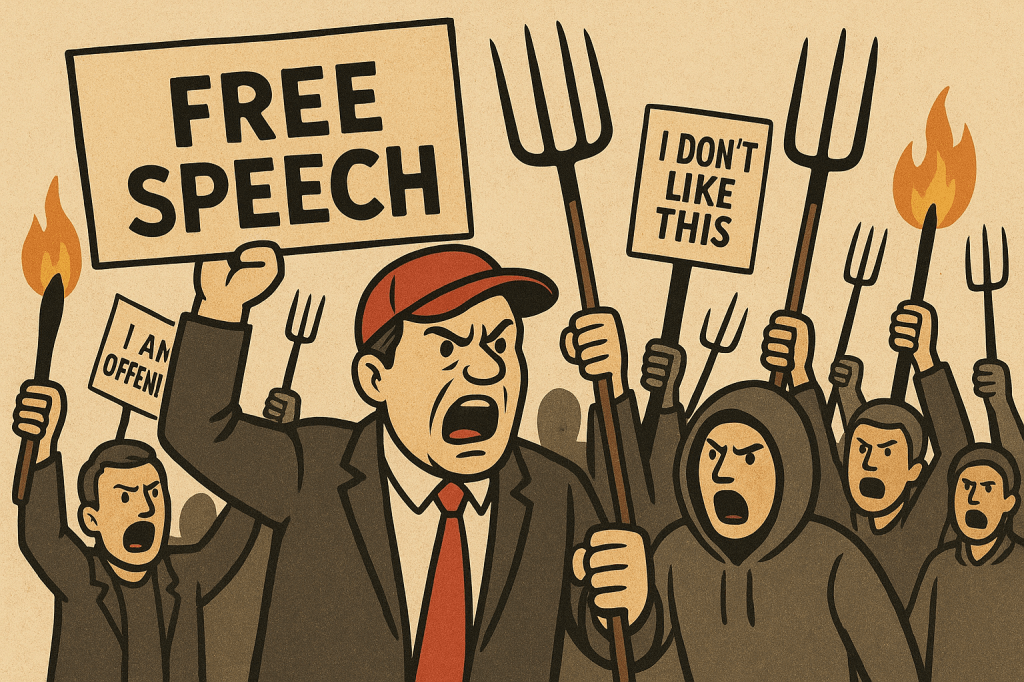
That means free speech isn’t preserved by canceling others, rallying outrage mobs, or gathering our proverbial pitchforks against those who hurt our feelings. That instinct to punish or silence only makes speech more fragile. Stop demanding censorship, start managing your own reactions.

If I want to preserve free speech, my civil duty is to control my response to ignorance, inflammatory rhetoric, and fearmongering. I may dislike it. I may be deeply offended by it. But I can accept its existence, because without that acceptance, I undermine the very freedom I claim to defend.

Freedom is not in demanding the right to say everything you wish. Freedom is in choosing how you respond to others. That is where your real power lies.

Take it back

Accountability as a Path to Growth

Human psychology exists for the purpose of survival. Much of what we do—consciously or unconsciously—stems from the instinct to protect ourselves. This can often show up in unpleasant ways such as selfishness, defensiveness, or even narcissism. This is because we cling to our sense of self, avoid shame, and fight to maintain control. When someone holds us accountable, or offers constructive feedback, it feels like a direct threat. This feedback threatens our fragile survival system.

But what if feedback isn’t a threat at all? What if it’s the very thing that helps us move closer to who we want to be?

Reframing Criticism

Most of us have been conditioned to see accountability as punitive – a consequence for getting “caught” doing something wrong. That mindset might work comfortably when it’s holding others accountable, but when the focus shifts to us, it triggers defensiveness, denial, or blame-shifting.

At its core, though, constructive feedback can be a mirror. It reflects how our actions affect others, reveals our blind spots, and increases self-awareness. Instead of viewing criticism as an attack, we can see accountability as an invitation- an opportunity to self-actualize. When we move from fear to receptiveness, feedback stops feeling like a strike against our worth and becomes a compass guiding us in a better direction.

From “Fuck You” to “Thank You”

Imagine a culture where feedback isn’t met with hostility but with gratitude. Instead of a reflexive “fuck you” when we’re challenged, we respond with “thank you.”

Thank you for helping me see what I couldn’t.

Thank you for trusting me enough to call me to corrective action.

Thank you for letting me know where you stand so I can properly adapt.

That small shift can have profound effects. It builds trust in relationships, strengthens communities, and creates workplaces and families where honesty isn’t feared but welcomed. Accountability stops being a weapon and becomes a gift when we reframe it.

Choosing Growth Over Defense

This isn’t easy. Our instinct to protect ourselves won’t disappear overnight. But each time we catch ourselves getting defensive, we have a choice: double down on pride, or lean into growth. The latter requires humility, vulnerability, and courage. Yet it also leads to freedom—the freedom that comes from knowing we don’t have to be perfect, only willing to learn.

Unconditional self acceptance is the foundation of this work. Only when we accept ourselves fully can we acknowledge our mistakes and embrace feedback without shame.

If we, collectively, begin to approach accountability this way, we will change not just our individual lives but the culture we live in. A culture less obsessed with defending the ego and more committed to becoming better, together.

So the next time someone calls you out—or calls you in—pause. Breathe. And maybe, just maybe, try saying “thank you.” This week, let’s choose one phrase as our accountability anchor. Use something like “Thank you, I’ll have to think about that.” Carry it with you. Practice using it the next time feedback comes your way.