

Why Insight Alone Can’t Change Your Mental Health

A 3D illustration of a human brain with mechanical gears integrated into its structure, glowing with a soft red light against a pale background.

Most of my clients have incredible insight into their mental health. Many people who attend CBT therapy for anxiety or depression already know what they’re supposed to do. They understand it intellectually but still struggle.

They know when their thoughts are irrational.

They know avoidance worsens anxiety.

They know isolation feeds depression.

And yet—nothing changes.

This gap between knowing and doing isn’t a lack of intelligence. It’s certainly not for lack of effort. It’s a misunderstanding of how psychological change actually happens.

Insight Alone Rarely Creates Change

Cognitive Behavioral Therapy (CBT) emphasizes the connection between thoughts, emotions, and behavior. Understanding your thinking patterns matters. Learning how to challenge unhelpful beliefs matters.

But insight alone rarely leads to sustainable growth.

Many people can accurately identify their cognitive distortions. They can explain why their anxiety “doesn’t make sense.” They may intellectually understand why avoidance keeps them stuck. Yet, they still feel anxious, depressed, or unmotivated. Sitting alone with your thoughts and repeatedly trying to think happy thoughts is not CBT. In fact, trying to think ourselves out of emotional distress often becomes exhausting.

Knowing what would help doesn’t automatically make it easier to do it.

Practice Over Theory

My clinical approach is grounded in Rational Emotive Behavior Therapy (REBT). This is a form of CBT that places particular emphasis on how rigid beliefs and internal demands fuel emotional distress.

From an REBT perspective, we work to replace demands (“shoulds,” “have tos,” and “musts”) with preferences. So we don’t have to do the work—we prefer to do the work, because we prefer to see progress.

But simply put, we still have to practice what we know.

Don’t just talk about it—be about it.

This applies to me as well. I can’t just preach mental health and wellness; I have to actively work at living by it. (Maybe that’s why they call it a private practice). What I practice in private tends to show up in the therapy office.

If I’m burned out, overextended, or ignoring my own limits, that doesn’t stay neatly contained outside of session. Practicing self-care isn’t just something I encourage—it’s something I actively work on. Being present, emotionally attuned, and grounded with clients requires ongoing practice, not just theoretical understanding. I am not alone, nor am I special. This is part of the human experience.

“I Give Great Advice—Just Not to Myself”

Many clients describe themselves as the wise friend—the one who gives thoughtful advice. They validate others’ emotions and see situations clearly from the outside. Yet, they struggle when it comes to their own life.

Often this happens because we:

  • Validate others’ emotions while minimizing our own
  • Apply compassion outward but demand perfection internally
  • Know what helps in theory but avoid it when it feels uncomfortable
  • Let ego convince us we “shouldn’t have to do the work”

This isn’t hypocrisy. It’s human behavior. And it reinforces the same idea: knowing is not the same as practicing.

When You Know What to Do—but Still Can’t Do It

A common frustration I hear in therapy sounds like this:

“I know I shouldn’t isolate, but when I’m depressed I don’t want to burden others.”
“I know structure or exercise would help, but I can’t get myself to start—or even get out of bed.”
“I know no one is judging me at this party, but I’m still worried I’ll look foolish.”

At this point, many people assume something is “wrong” with them. In reality, they’re encountering a very normal limitation of insight-based change.

CBT isn’t about waiting to feel better before acting. It’s about learning how to act while uncomfortable. Or, as I like to say, the beauty is in the work.

Midsteps: Acting Without Needing to Feel Ready

When anxiety or depression is present, meaningful change rarely comes from trying harder or thinking more rationally first. Instead, we focus on midsteps—small, intentional actions that are possible even when motivation is low.

For example:

You don’t go to the crowded store, but you walk to the mailbox
You don’t socialize for hours, but you step outside briefly
You don’t feel confident, but you take action anyway

These steps aren’t about eliminating discomfort. They’re about moving through it—gradually demonstrating to yourself that you can withstand it.

Experiential Knowledge Is What Changes Beliefs

In CBT and REBT, beliefs change most reliably through experience—not logic alone. While we may brainstorm cognitive reframes in session to reduce stress and anxiety, long-term growth comes from experiential learning and resilience-building.

Experiential knowledge is built by:

  • Doing difficult things while anxious
  • Acting while depressed, unmotivated, or self-critical
  • Learning firsthand that discomfort is tolerable
  • Developing resilience to frustration

Sometimes those actions feel empowering. Other times they come with sweating, self-doubt, tears, or a pit in your stomach.

It all counts.

Each experience provides evidence that:

“I can tolerate discomfort and still function. I can withstand this.”

Over time, this weakens avoidance and reshapes emotional responses—not through positive thinking, but through repeated practice.

Therapy as a Place to Practice, Not Just Understand

Therapy isn’t about convincing yourself you shouldn’t feel anxious or depressed.

It’s about learning how to act effectively while you do.

For clients seeking CBT therapy for anxiety or depression, this approach often resonates with people. It particularly appeals to those who value self-improvement. They emphasize personal responsibility and intellectually honest change.

That’s why knowing isn’t enough—and why meaningful progress comes from practice over theory.
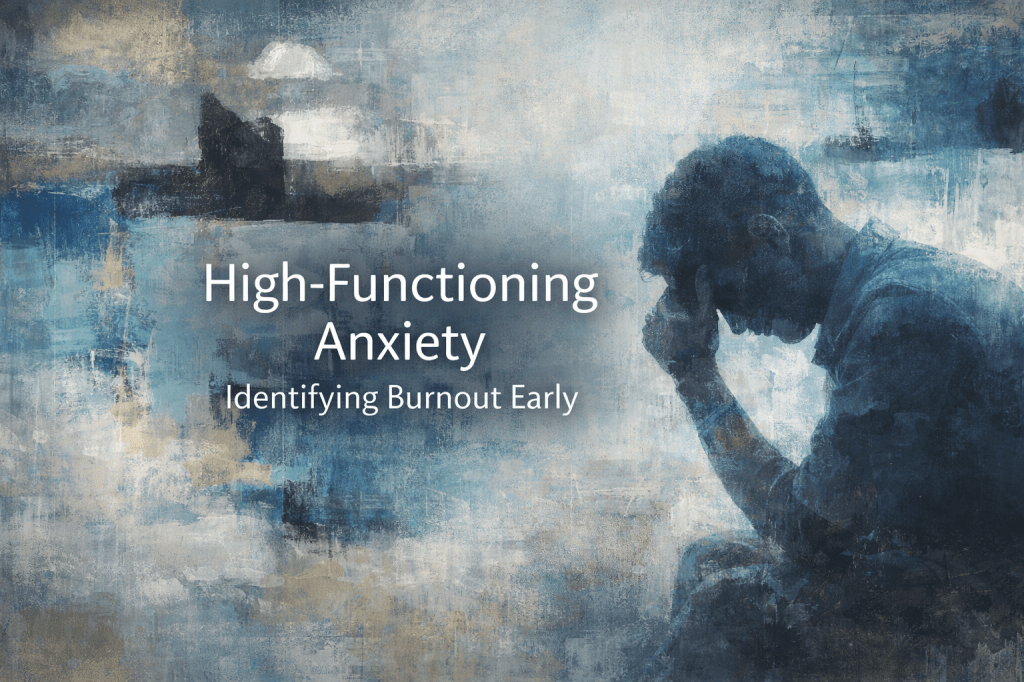
High-Functioning Anxiety: Identifying Burnout Early

An abstract image depicting a person in a thoughtful pose, symbolizing high-functioning anxiety and burnout, with a blue and grey color palette. The text overlay reads 'High-Functioning Anxiety' and 'Identifying Burnout Early.'

High-functioning anxiety often goes unnoticed—not because it isn’t painful, but because it works.

From the outside, it can look like success. Competence. Leadership. Reliability.

On the inside, it often feels like never being able to fully exhale.

Many people with high-functioning anxiety don’t realize they’re burning out until their nervous system forces a stop.

What High-Functioning Anxiety Can Look Like

A close-up of a young businessman with blue eyes and styled hair, looking serious in an office setting, with a blurred figure in the background holding a document.

High-functioning anxiety doesn’t always show up as panic or avoidance. More often, it shows up as traits that are rewarded.

  • Reliability: Always following through. Always doing what you said you would do—often driven by internal pressure, perfectionism, or fear of letting others down.
  • Productivity: A strong need to prove yourself. Seeking reassurance through achievement, output, or external validation.
  • Leadership Skills: Being highly attuned to other people’s needs, moods, and expectations—sometimes at the expense of your own.
  • Problem-Solving: Constantly scanning the environment for potential issues or threats. Always thinking ahead. Always preparing.

These traits can lead to professional or financial success. This is why it’s so hard to identify them and reduce them when needed.

When Functioning Turns Into Exhaustion

Over time, this way of operating takes a toll.

High-functioning anxiety often leads to burnout marked by:

  • Always having to be on.
  • Difficulty enjoying success because you’re focused on preserving it.
  • Impostor syndrome—worrying you’ll be “found out”
  • Future-tripping instead of being present
  • A persistent lack of joy, satisfaction, or ease
  • Rarely stopping to enjoy what you’ve already achieved

You may technically be doing well—yet feel disconnected, restless, or chronically tired.

Why Letting Go Feels So Hard

One of the biggest challenges with high-functioning anxiety is that the anxiety has worked.

It may have helped you:

  • reach goals
  • advance your career
  • create stability
  • earn respect

So the idea of loosening control can feel dangerous.

Many people worry:

“If I stop pushing myself, everything will fall apart.”

From Demands to Preferences

A key shift in reducing burnout and perfectionism is learning to move from demanding thinking to preference-based thinking. We identify demand thinking with buzz words like: should, have to, or must.

Demanding thoughts sound like:

I must succeed to justify my position in life.

I have to hit this metric to prove my worth.

I should be doing more or I am going to fail.

Preference-based thoughts sound like:

I prefer to succeed. (I do not have to succeed in all aspects of my life to be valuable)

I’d like to hit this metric. (I can adapt if I don’t hit each metric for each task. I don’t have to prove my worth)

I want to achieve this goal. (I can accept if I don’t achieve goals exactly when I want. Failure is not fatal)

The difference matters.

When goals become demands, your worth gets tied to outcomes.

When goals remain preferences, effort and value can coexist—even when things don’t go ideally.

Your worth does not increase when you achieve more, and it does not disappear when you fall short.

A close-up of a handwritten note that says 'You are enough' on a lined notebook page.
Photo by Bich Tran on Pexels.com

Learning to Be “Good Enough” on Purpose

For many people with high-functioning anxiety, healing doesn’t come from trying harder—it comes from intentionally doing less.

This can include:

  • Allowing small mistakes
  • Letting yourself under-perform occasionally
  • Resisting the urge to always max out
  • Practicing being uncomfortable without fixing it

This isn’t about lowering standards—it’s about increasing flexibility.

In therapeutic work, this often looks like a form of exposure:

learning to tolerate imperfection and uncertainty so your nervous system can finally stand down.

The Goal Isn’t Less Success—It’s More Presence

A hiker standing atop a rocky peak with arms outstretched, basking in the sunlight against a scenic mountain backdrop.

Reducing high-functioning anxiety doesn’t mean giving up ambition.

It means creating space to:

  1. enjoy what you’ve already built
  2. feel present in your life
  3. experience satisfaction without immediately chasing the next goal
  4. increase self-esteem or self worthiness

Burnout is not a personal failure.

It’s often a signal that the system you’ve been using no longer serves you.

A Gentle Next Step

If this resonates, you’re not broken—and you’re not alone.

You don’t have to wait until everything collapses to get support.

Learning to relate differently to achievement, pressure, and self-worth can restore energy, presence, and a sense of ease that anxiety quietly steals.

Therapy FAQs: Why Am I Not Seeing Progress?

One of the most common frustrations I hear in therapy is some version of:

“I’m doing the work… but I don’t feel like I’m making progress.”

That feeling can be discouraging. People accustomed to measuring growth may question therapy’s effectiveness. Those concerned with improvement or productivity might also doubt if therapy is working.

Not seeing growth in therapy doesn’t mean nothing is happening. More often, it means progress is showing up in ways that are slower. It can be subtler and also harder to measure than we expect.

Here are a few reasons why therapy can feel stagnant even when meaningful change is happening.

1. Change Is Slow

We live in a world of immediate gratification. When something doesn’t produce quick results, it’s easy to assume it isn’t effective.

Cognitive Behavioral Therapy isn’t fast-acting in the way people often hope for. But it is long-lasting. Real change tends to happen gradually, through repetition, practice, and consistency—not sudden insight alone.

That slowness can be frustrating, especially if you’re used to seeing effort quickly turn into outcomes.

2. Change Is Subtle

We love watching our kids grow up, but we don’t notice their growth day by day.

The same is true for our own personal growth.

Subtle progress is hard to see—even when it’s happening. When change occurs in small increments, it often only becomes visible in hindsight. That makes it easy to overlook and dismiss in the moment.

3. You’re Not Used to Looking for Progress

Many people I work with are high-demand, operating-at-maximum-efficiency types.

Your brain is used to looking for the deficit, not the progress.

By “deficit,” I mean the area short of perfection—the place where you could still improve. When your mind is trained this way, it becomes very good at spotting problems and very bad at taking inventory of wins.

We get so used to asking “What still needs work?” that we rarely pause to notice what has changed.

CBT sessions help slow this process down and intentionally identify progress—even when that progress is simply prioritizing mental health by showing up consistently to sessions.

That still counts.

4. Progress Is Not Linear

If we start plotting points of happiness or progress, it becomes clear pretty quickly that growth isn’t a straight line.

You’re not always going to feel good.

You’re not always going to be successful.

Sometimes you stub your toe.

Sometimes you get sick.

Sometimes you react to a trigger in a way you wish you hadn’t.

Those moments are just that—moments. Not the journey.

Temporary setbacks don’t erase progress. They’re part of it.

5. You’re Trying… But Are You Really Trying?

Photo by Tima Miroshnichenko on Pexels.com

Effort can be difficult to define, especially in therapy.

It’s easy to feel like you’re trying just by talking about things in session. But are you doing the work outside of therapy?

That might look like:

Journaling Taking breaks Practicing boundaries Prioritizing the right kind of self-care

Insight matters—but insight alone rarely creates change. Behavior and practice are where progress tends to take root.

6. Effort Doesn’t Equal Outcome

This part is important—and often overlooked.

Sometimes we are doing the work.

We can do the right things, and it still doesn’t mean we’ll get the desired results—at least not yet.

That doesn’t mean the effort is wasted.

Keep up the effort.

Keep noticing the effort.

Give yourself some damn credit.

And trust the process.

Final Thoughts

Therapy isn’t about constant improvement or feeling better all the time. It’s about learning how to relate differently to your thoughts, emotions, and behaviors over time.

If therapy feels slow or frustrating, that doesn’t mean it isn’t working. It may mean the changes you’re making are quieter, deeper, and still unfolding.

Those changes tend to last.